
NUCLEAR PHYSICS LABORATORY
Radioactive Decay & Nuclear Transformation Calculator
Explore alpha decay, beta-minus decay, beta-plus decay, electron capture, gamma emission, radioactive decay chains, half-life, particle production, quark transformations, and electron–positron annihilation.
Calculator
LEARN THE PHYSICS
Topic Navigator
Jump directly to any concept. The material is ordered to build understanding step by step.
Atoms & Elements
An element is defined by the number of protons in its nucleus — its atomic number, Z. Every nucleus with Z = 6 is carbon; every nucleus with Z = 8 is oxygen. Change the number of protons and you change the element.
The total number of protons and neutrons is the mass (nucleon) number, A. The number of neutrons is N = A − Z.
Isotopes
Isotopes of an element have the same number of protons but different numbers of neutrons — so the same Z but different A.
For example, carbon-12 (⁶C, 6 protons + 6 neutrons), carbon-13 (7 neutrons), and carbon-14 (8 neutrons) are all carbon (Z = 6) but different isotopes.
Nuclear Notation
A nucleus is written with the mass number on top and the atomic number on the bottom, beside the chemical symbol:
Here A = 18, Z = 8, so N = 10. This is oxygen-18: 8 protons, 10 neutrons, 18 nucleons.
Why Nuclei Decay
Some nuclei are unstable because their particular arrangement of protons and neutrons is not the most energetically favorable. The balance between the strong nuclear force (which binds nucleons together) and the electrostatic repulsion between protons determines stability.
An unstable nucleus may spontaneously transform toward a lower-energy, more stable configuration — emitting particles and energy in the process. This is radioactive decay.
Importantly, radioactive decay is probabilistic. We cannot predict exactly when any single unstable nucleus will decay. But for a large collection of identical nuclei, the statistical behavior is highly predictable — this is what half-life describes.
Types of Radioactive Decay
The five main decay processes:
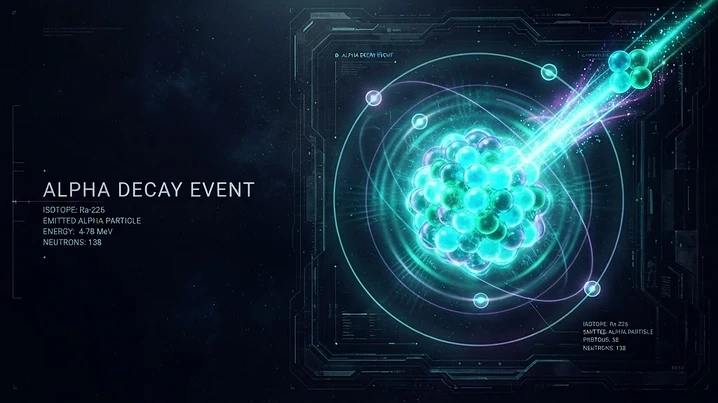
Alpha (α)
ᴬ_ZX → ᴬ⁻⁴_Z₋₂Y + ⁴₂He
ΔA = −4, ΔZ = −2
Emitted: α (helium-4 nucleus)
Emits 2 protons + 2 neutrons.
Beta-Minus (β−)
n → p + e⁻ + ν̄ₑ
ΔA = 0, ΔZ = +1
Emitted: electron + antineutrino
A neutron becomes a proton.
Beta-Plus (β+)
p → n + e⁺ + νₑ
ΔA = 0, ΔZ = −1
Emitted: positron + neutrino
A proton becomes a neutron.
Electron Capture
p + e⁻ → n + νₑ
ΔA = 0, ΔZ = −1
Emitted: neutrino only
Same daughter as β+; no positron emitted.
Gamma (γ)
X* → X + γ
ΔA = 0, ΔZ = 0
Emitted: gamma photon
Excited nucleus releases energy; element unchanged.
Quarks & Beta Decay
Protons and neutrons are made of quarks: a proton is uud (two up, one down); a neutron is udd.
In beta decay, a quark changes flavor through the weak interaction — a down quark becomes an up quark (β−) or vice versa (β+). Explore it interactively:
Quark Transformation Explorer
Neutron
Weak Interaction
d → u + W⁻
W⁻ → e⁻ + ν̄ₑ
A quark changes flavor (d → u) through the weak interaction, mediated by the W⁻ boson. The W⁻ then decays into e⁻ and ν̄ₑ. This is why the atomic number increases while the mass number stays the same.
The Weak Interaction
The weak interaction is one of the four fundamental forces, and the only one that can change one quark flavor into another. In beta-minus decay: d → u + W⁻, then W⁻ → e⁻ + ν̄ₑ. In beta-plus: u → d + W⁺, then W⁺ → e⁺ + νₑ.
The W boson is very massive and short-lived, which is why weak-interaction processes are relatively slow.
Antimatter & Annihilation
The positron (e⁺) is the antiparticle of the electron: same rest mass, opposite charge (+e vs −e).
When an electron and positron meet they annihilate, converting their rest mass into energy. At rest, the standard two-photon model gives: e⁻ + e⁺ → γ + γ.
Each photon carries ≈ 511 keV (the electron rest energy), so a pair yields ≈ 1.022 MeV. Momentum conservation requires the two photons to travel in opposite directions when the initial pair has zero net momentum.
Gamma Photons & Energy
Gamma rays are high-energy photons. Their energy follows E = hf (Planck's relation) and c = fλ, so knowing any one of energy, frequency, or wavelength gives the others.
Gamma emission does not change the element or isotope — it only carries away excess energy as an excited nucleus relaxes.
Half-Life
The half-life (T½) is the time for half of a sample's radioactive nuclei to decay. After n half-lives, the fraction remaining is (½)ⁿ.
Equivalently: N = N₀·e^(−λt), where the decay constant λ = ln(2)/T½. This exponential law reflects the probabilistic, memoryless nature of decay.
Activity
Activity (R) is the number of decays per unit time: R = λN, measured in becquerels (1 Bq = 1 decay/s).
Activity depends on both how many nuclei remain and how quickly each one is likely to decay (λ).
Conservation Laws
Every nuclear reaction must conserve:
- Nucleon (baryon) number — total A is the same before and after.
- Electric charge — total Z is the same before and after.
- Lepton number — electrons and neutrinos count +1; positrons and antineutrinos count −1.
For example, beta-minus decay without the antineutrino would violate lepton number — which is why the antineutrino must be emitted.
ZUL'ELKOEN CONTEXT (FICTIONAL)
Where this physics appears in the universe
The physics above is always real-world science. These are fictional applications within the Zul'Elkoen universe — they never alter the calculations:
- MEDODVA nuclear medicine — radioisotope diagnostics and therapy.
- KAVOE radiation monitoring aboard Consortium vessels.
- Radioisotope power sources for long-duration probes.
- Antimatter propulsion research (positron annihilation energy).
- Planetary radiation surveys during expeditionary operations.
Practice
IDENTIFY PARENT NUCLEUS · INTERMEDIATE
After beta-plus decay, a daughter nucleus has A = 60 and Z = 28. What were the parent's A and Z?
All practice questions are generated originally from physics principles — no examination content is reproduced.

