
Survivor: Exoplanet Extreme
A high-stakes interstellar survival competition in which contestants must endure a sequence of increasingly dangerous environments using no advanced technology other than tools, shelters, weapons, containers, or other equipment they construct themselves from permitted materials found or provided within the competition environment.


Core Competition Structure
10 Contestants
Begin the competition
9 Rounds
One fewer keystone each round
1 Winner
Takes the grand prize
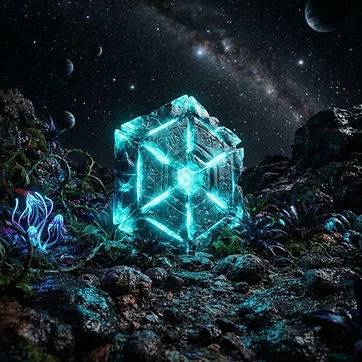
Each round contains exactly one fewer keystone than there are active contestants. The first round has ten contestants and nine keystones; the next has nine and eight. This pattern continues until the final round, when two contestants compete for a single keystone.
A contestant is eliminated by quitting, dying, or failing to satisfy the round's required objective before the deadline. Because there are always fewer keystones than contestants, at least one person must be eliminated during every round regardless of how effectively the contestants cooperate.
Technology Restriction: Contestants cannot rely on ordinary advanced technology. They must survive through their own judgment, physical abilities, species-specific adaptations, cooperation, and whatever equipment they can construct themselves under the rules of the game.
Competition Worlds
Frigid World
Humans excel hereA severe cold-weather environment emphasizing shelter, heat conservation, food acquisition, movement across frozen terrain, and resistance to prolonged exposure. Humans tend to perform comparatively well in this environment.
Desert World
Zelmoks excel hereA hot, arid environment emphasizing water acquisition, thermal management, navigation, and survival across exposed terrain. Zelmoks tend to perform especially well on desert worlds.
Forest World
Humans excel hereA densely vegetated environment emphasizing navigation, shelter construction, food identification, climbing, concealment, and encounters with unfamiliar organisms. Humans tend to perform comparatively well in forest environments.
Swamp World
No inherent advantageA wet, unstable environment emphasizing movement through difficult terrain, water safety, parasites, microorganisms, shelter placement, and navigation where solid ground may be scarce.
Cavernous World
No inherent advantageA world or region dominated by enormous cave systems. Contestants must contend with darkness, vertical terrain, confined spaces, underground water systems, difficult navigation, and organisms adapted to subterranean environments.
Ulopsid World
Squelgians excel hereContestants survive upon massive floating organisms called Ulopsids that inhabit the atmospheres of gas giants. Ulopsids are nonpredatory leviathans approximately two to three kilometers long. Their head regions support large fungal-like organisms, plants, animals, and other life, effectively forming moving aerial ecosystems.
Balequos Station
Psychological horrorThe final environment is an abandoned or otherwise mysterious space station constructed by the Balequos from the star HP 11915. The station changes the competition from wilderness survival into archaeological survival and psychological horror. The final two contestants search for a single keystone within the station.
The Nine Rounds
Keystone Economy

Per-Round Awards
Each successful keystone earns 1 million uhzahs. The value increases by 1 million uhzahs per round. Continued survival produces increasingly large personal winnings even for contestants who do not ultimately win.
Death Provision
If a contestant dies during the competition, money already earned passes to the contestant's family. This provision makes death, quitting, and ordinary elimination economically different outcomes.
Alliance Dynamics
Alliances are permitted. Contestants may share food, shelter, information, labor, and protection. However, the number of keystones never changes to accommodate an alliance. The mathematics of the competition therefore guarantees that every alliance eventually faces an internal conflict: cooperation may improve everyone's chances of reaching a keystone, but the group can never carry all of its members indefinitely.
Grand Prize & The Balequos Finale
The Moon Prize
The final winner receives one of the most unusual prizes in Consortium entertainment: the next moon discovered by the Consortium during an eligible survey is named after the winner, and the resources discovered on that moon belong to the winner under the terms of the game. Even relatively small moons may contain immense mineral wealth or possess strategic value to governments, corporations, settlements, or other factions.
Psychological Effects of the Station
The Balequos station produces increasingly severe psychological effects. Contestants may see alien spirits that speak to them, hear the voices of deceased loved ones, or perceive unseen laughter and applause. Memories, sounds, visual perceptions, and emotional responses become progressively less reliable.
The Hidden Tests: Reconciliation & Mercy
A contestant who sincerely apologizes to a manifestation of a deceased enemy or expresses genuine forgiveness receives assistance from the station. At the core, if the dominant finalist chooses compassion and spares the defeated opponent, a silent Balequos female appears and leads them to the final keystone. A contestant who kills instead finds no chamber, no female, and must search alone as the clock runs down. Survival alone does not constitute victory.
Creator
Vladimir Stalin
A wealthy businessman whose private organization operates the competition. The game was created by Stalin and is privately operated. All competition environments are located outside Consortium space. This separation is fundamental to the program's legal and political identity, particularly because lethal violence between contestants is permitted under the competition rules.

