
Ventopia
ORGANIZATION · THE LURRAN CONSORTIUM
"To Make the Impossible Livable."
"Planets are not discovered. They are engineered."
THE ORGANIZATION
Overview
Ventopia is one of humanity's largest and most technologically advanced colonial organizations within the Lurran Consortium. Unlike a traditional corporation, Ventopia functions simultaneously as a scientific institution, an industrial conglomerate, a colonial government, and a planetary engineering organization.
Its purpose is simple yet extraordinarily ambitious:
To transform hostile alien worlds into thriving homes for humanity.
Where other organizations search for naturally habitable planets, Ventopia specializes in creating habitable worlds.
By the late twenty-fourth century, Ventopia governs numerous colonies across known space, each established on worlds that were once considered unsuitable—or even impossible—for long-term human habitation. Colonies are often identified by numerical designations, such as Ventopia Colony 46B on the desert world of Thestias, where the events of The Sand Witch unfold.
INDUSTRIES
ORIGINS
History
Ventopia emerged during humanity's great era of interstellar expansion, when explorers discovered that relatively few exoplanets naturally possessed Earth-like conditions.
Most candidate worlds suffered from one or more severe obstacles:
- toxic atmospheres
- excessive radiation
- unstable climates
- insufficient oxygen
- limited liquid water
- poor soil quality
- low atmospheric pressure
Rather than abandoning these worlds, Ventopia developed technologies capable of reshaping entire planetary environments.
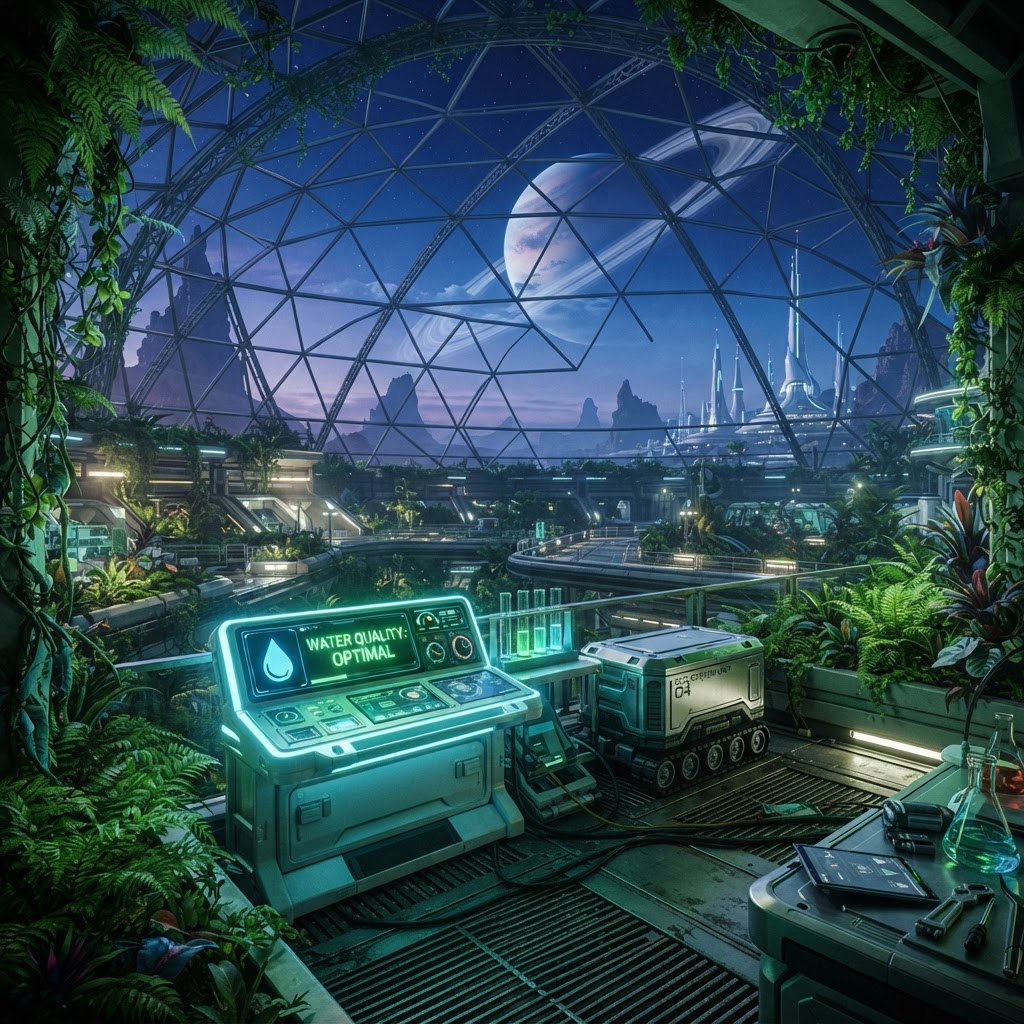
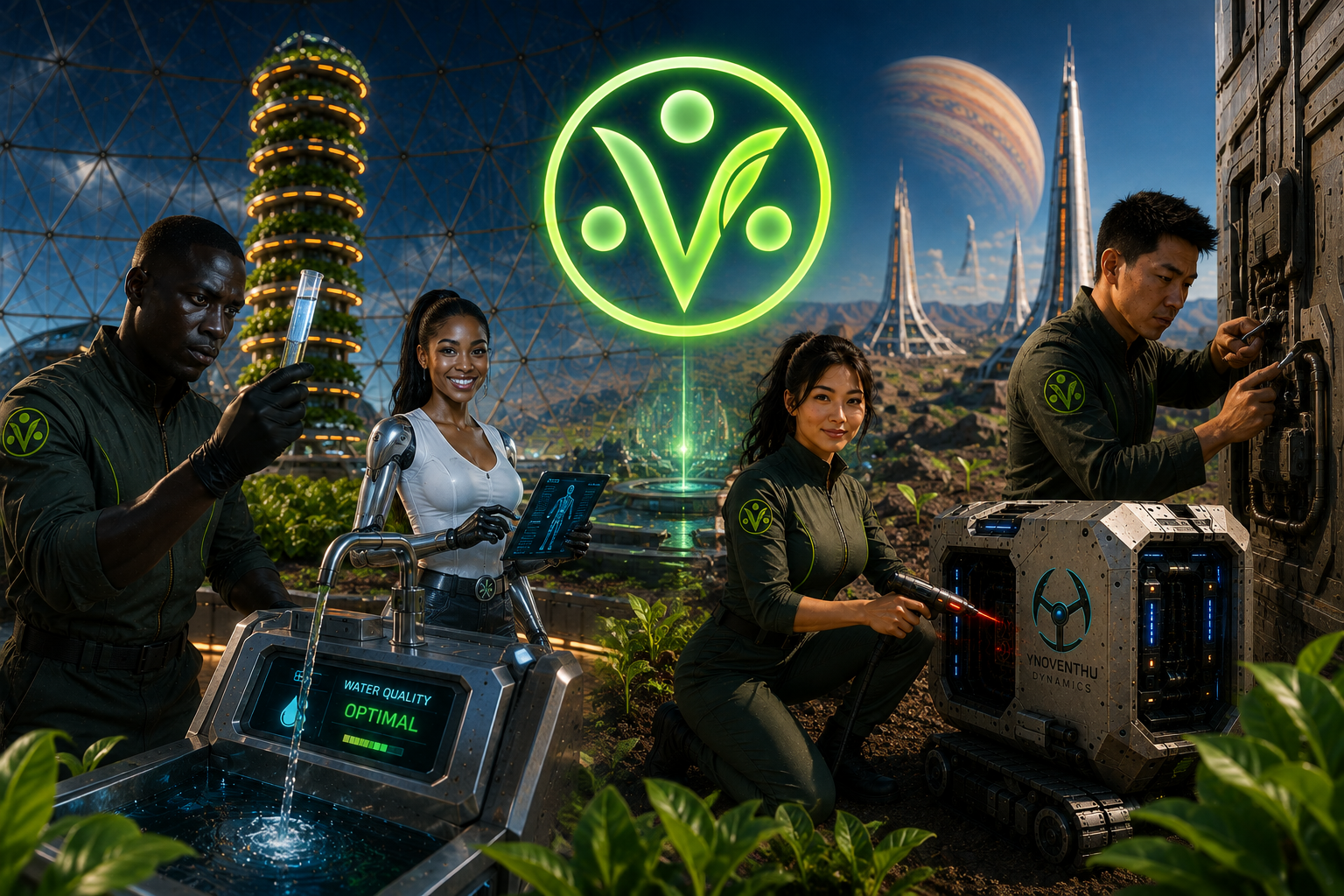
Its earliest colonies consisted of sealed research domes surrounded by fleets of automated construction systems slowly transforming hostile landscapes into functioning ecosystems. Atmospheric processors, orbital mirrors, weather-control satellites, engineered plants, robotic agricultural systems, and water extraction networks eventually allowed these barren worlds to support permanent human populations.
CREDO
Philosophy
Ventopia's philosophy is summarized by one fundamental belief:
Planets are not discovered. They are engineered.
Rather than adapting humanity to alien worlds, Ventopia adapts alien worlds to humanity.
Its scientists routinely alter nearly every aspect of an environment, including:
- atmosphere
- hydrology
- climate
- geology
- agriculture
- ecology
- microbiology
- genetics
Entire ecosystems may be designed from the ground up when natural biological systems cannot accomplish the desired objective.

Sustaining Life · Building Worlds
THE SCIENCES
Scientific Disciplines
Ventopia integrates numerous scientific fields under one organization.
Terraforming Division
Responsible for making planets permanently habitable.
- atmospheric conversion
- climate regulation
- ozone generation
- enhancement of planetary magnetic fields
Agricultural Sciences
Develops sustainable food production systems for hostile worlds.
- engineered crops
- irrigation
- water management
- floating oxygen-producing meraphytes
- pest control
Li-Ming Phan serves within this division as both an agricultural engineer and an electrical engineer responsible for maintaining Colony 46B's automated pest-control network.
Xenobiology
Studies alien organisms and evaluates their compatibility with human settlements.
- alien diseases
- ecological interactions
- environmental hazards
- biological adaptation
Genetic Engineering
Perhaps Ventopia's most controversial department.
- plants
- animals
- microorganisms
- beneficial bacteria
When necessary, entirely new organisms are engineered to perform ecological functions impossible for naturally evolved life.
Resource Engineering
Responsible for the practical infrastructure of colonies.
- mining
- industrial production
- energy systems
- water extraction
Robotics Division
Develops autonomous machines used throughout Ventopia colonies.
- HAVs (Horticultural Adjustment Vehicles)
- maintenance robots
- agricultural drones
- industrial automation systems
DIGITAL INTELLIGENCE
Artificial Intelligence and Senticom Integration
Ventopia makes extensive use of advanced digital intelligence.
Among the best known is TREODVA, a sentient digital entity capable of assisting scientists with:
- biological simulations
- diagnostics
- genetic modeling
- research analysis
TREODVA demonstrates how deeply senticom technology has become integrated into frontier science.
AUTHORITY
Government
Unlike ordinary corporations, Ventopia directly governs many of its colonies.
Typical leadership includes:
- Colony Director
- Assistant Directors
- Department Directors
- Scientific Councils
- Security Administration
This governmental role allows Ventopia to make rapid scientific and logistical decisions without relying upon distant planetary governments.
COMMERCE
Ventopia Industries
Beyond governing colonies, Ventopia maintains a vast commercial research division devoted to advancing biological science and environmental engineering.
Its research facilities include exhibits and laboratories dedicated to:
- biotechnology
- gene editing
- engineered organisms
- advanced agriculture
- senticom-assisted scientific research
These facilities represent some of the most advanced biological laboratories in human space.
MISSION
Core Objectives
Ventopia's mission can be summarized by six long-term goals:
- Expand human civilization beyond Sol.
- Terraform hostile planets into permanent homes.
- Achieve agricultural independence for every colony.
- Advance biology, genetics, ecology, robotics, and medicine.
- Preserve humanity by reducing dependence upon any single world.
- Encourage bold scientific innovation.
PERCEPTION
Reputation
Ventopia is widely admired throughout the Lurran Consortium for its scientific accomplishments.
It is especially respected for:
- unmatched terraforming expertise
- advanced genetics
- cutting-edge robotics
- exceptional agricultural technology
- highly educated scientific workforce
- rapid adaptation to hostile environments
Many of humanity's greatest scientific breakthroughs originated within Ventopia laboratories.
CONTROVERSY
Criticism
Despite its achievements, Ventopia remains controversial.
Critics argue that the organization:
- alters ecosystems too aggressively
- relies excessively on genetic engineering
- places scientific progress ahead of ethical caution
- interferes with natural evolutionary processes
- allows political considerations to influence scientific decisions
Supporters counter that without Ventopia's willingness to innovate, many colonies simply would not exist.
THE BIGGER PICTURE
Role in the Zul'Elkoen Universe
Ventopia represents humanity's determination to expand beyond the limitations imposed by nature. Rather than waiting for ideal worlds to be discovered, its scientists, engineers, and colonists create them through ingenuity, perseverance, and interdisciplinary science.
The organization serves as the backdrop for The Sand Witch, where debates over colonial independence, resource scarcity, engineered organisms, and scientific ethics illustrate both the promise and the burden of reshaping entire worlds. Through Ventopia, the Zul'Elkoen universe explores one of its central themes: that humanity's greatest frontier is not merely the exploration of space, but the responsible creation of new homes among the stars.
SUBSECTION
Ventopia's Genetic Terraforming Program
APPROACH
Philosophy
Unlike twentieth-century terraforming proposals, which focused almost entirely on machines, Ventopia believes that biology is the most efficient planetary engineer.
Instead of relying solely on atmospheric processors and orbital mirrors, Ventopia creates living organisms capable of reshaping an entire planet over decades.
Their philosophy can be summarized as:
"Machines build worlds. Life sustains them."
PHASE I
Planetary Survey
Before introducing a single organism, Ventopia spends years studying the target world.
- atmospheric chemistry
- soil mineral composition
- groundwater
- native microorganisms
- ultraviolet radiation
- gravity
- seasonal temperature variation
- tectonic activity
- weather systems
Only after understanding the planet's natural processes does biological engineering begin.
PHASE II
Pioneer Microorganisms
The first organisms introduced are almost always genetically engineered microbes.
- fix atmospheric nitrogen
- release oxygen
- bind toxic metals
- produce organic soils
- stabilize sand dunes
- recycle sulfur compounds
- reduce acidity
Entire continents may initially be transformed by microorganisms invisible to the naked eye.
PHASE III
Engineered Plants
Once primitive soils exist, Ventopia introduces specially engineered vegetation. Different plants perform different ecological functions.
Atmospheric Forests
Gigantic fast-growing trees optimized for oxygen production, carbon fixation, and moisture recycling.
Nitrogen Gardens
Plants hosting engineered symbiotic bacteria that enrich poor soils.
Water Collectors
Plants capable of extracting moisture directly from thin atmospheres or morning fog.
Radiation Mosses
Ground-cover organisms that tolerate intense ultraviolet radiation while gradually creating fertile topsoil.
Salt Forests
Plants capable of removing excessive salts from ancient ocean basins.
PHASE IV
Engineered Animals
Only after stable ecosystems begin forming does Ventopia introduce larger organisms. Most animals are modified to perform ecological work.
Pollinators
Engineered insects that rapidly spread pollen across newly planted forests.
Soil Turners
Burrowing animals that aerate soil while distributing microorganisms.
Grazers
Herbivores designed to regulate plant growth before natural predators are introduced.
Seed Distributors
Bird-like organisms engineered to spread vegetation over enormous distances.
Detritivores
Organisms that rapidly recycle dead biological material into nutrients.
PHASE V
Ecosystem Stabilization
Once thousands of engineered species become established, Ventopia gradually reduces direct intervention.
- biodiversity
- oxygen production
- nutrient cycles
- predator-prey balance
- disease emergence
- invasive tendencies
Some engineered organisms eventually become so well adapted that they evolve beyond their original design. At this point, the ecosystem becomes largely self-sustaining.
METHODS
Genetic Technologies
Ventopia scientists routinely employ:
- synthetic chromosomes
- gene editing
- artificial genomes
- engineered chloroplasts
- designer microbiomes
- symbiotic bacterial systems
- accelerated adaptation algorithms
Many species are not modifications of Earth organisms but entirely new lifeforms designed for specific ecological roles.
CASE STUDY
Example: Thestias
On the desert world Thestias, Ventopia engineers floating oxygen-producing meraphytes that contribute to atmospheric renewal while surviving the planet's harsh conditions. Agricultural engineers such as Li-Ming Phan work to sustain these systems alongside automated pest-control networks.
Related Technology
Meraphytes
Ventopia's signature floating terraforming plants — and the crisis that nearly destroyed them.
DEBATE
Ethical Questions
Ventopia's work raises profound philosophical and scientific debates throughout the Lurran Consortium.
1. Is an Artificial Ecosystem Truly Nature?
Critics argue that a planet populated primarily by engineered organisms is no longer "natural." Ventopia responds that every ecosystem changes over time and that their work merely accelerates ecological succession.
2. Native Life
Should alien microorganisms be preserved? Or should they be replaced if they prevent human colonization? Some argue that native ecosystems possess intrinsic value regardless of whether they benefit humanity. Others maintain that making worlds habitable for billions of people is a moral imperative.
3. Playing God
Religious organizations sometimes accuse Ventopia of assuming a role reserved for a creator. Supporters counter that humanity has altered ecosystems since the dawn of agriculture and that terraforming is simply the next step in stewardship.
4. Ownership of Life
If Ventopia designs an organism: Who owns it? Can it be patented? Can colonists modify it? What happens after the corporation leaves? These questions frequently appear before Consortium courts.
5. Evolution Beyond Design
Engineered organisms evolve. Eventually they become something Ventopia never intended. Some scientists argue that releasing self-evolving life is irresponsible. Others argue that true ecosystems require evolution.
6. Ecological Irreversibility
Terraforming may permanently erase an alien world's original character. Future generations might never know what the planet originally looked like. This creates ongoing debates between preservationists and expansionists.
7. Human Adaptation vs. Planetary Adaptation
Some philosophers ask whether humans should modify planets — or genetically modify themselves to live on those planets instead. Ventopia overwhelmingly supports changing the environment rather than fundamentally altering human biology, preserving a common human physiology across the Consortium.
LEGACY
Public Perception
Ventopia remains one of the most respected—and controversial—organizations in human space.
Supporters credit it with making dozens of worlds habitable and enabling humanity's expansion across the stars. They argue that without Ventopia's innovations, billions of people would never have had the opportunity to build new lives beyond Sol.
Critics contend that the organization sometimes treats entire planets as engineering projects rather than living worlds, questioning whether technological capability should always justify ecological transformation.
This tension makes Ventopia more than a terraforming company—it becomes one of the central arenas in the Zul'Elkoen universe for exploring the balance between scientific progress, environmental responsibility, and humanity's future among the stars.
Related Organization
SIAGE — Sheraton Institute of Advanced Genetics
Where Ventopia engineers worlds, SIAGE engineers the life that inhabits them.

