
SPECIES · THE UNSEEN ADVERSARIES
Leirth
A Technologically Advanced Civilization of the Contested Reach
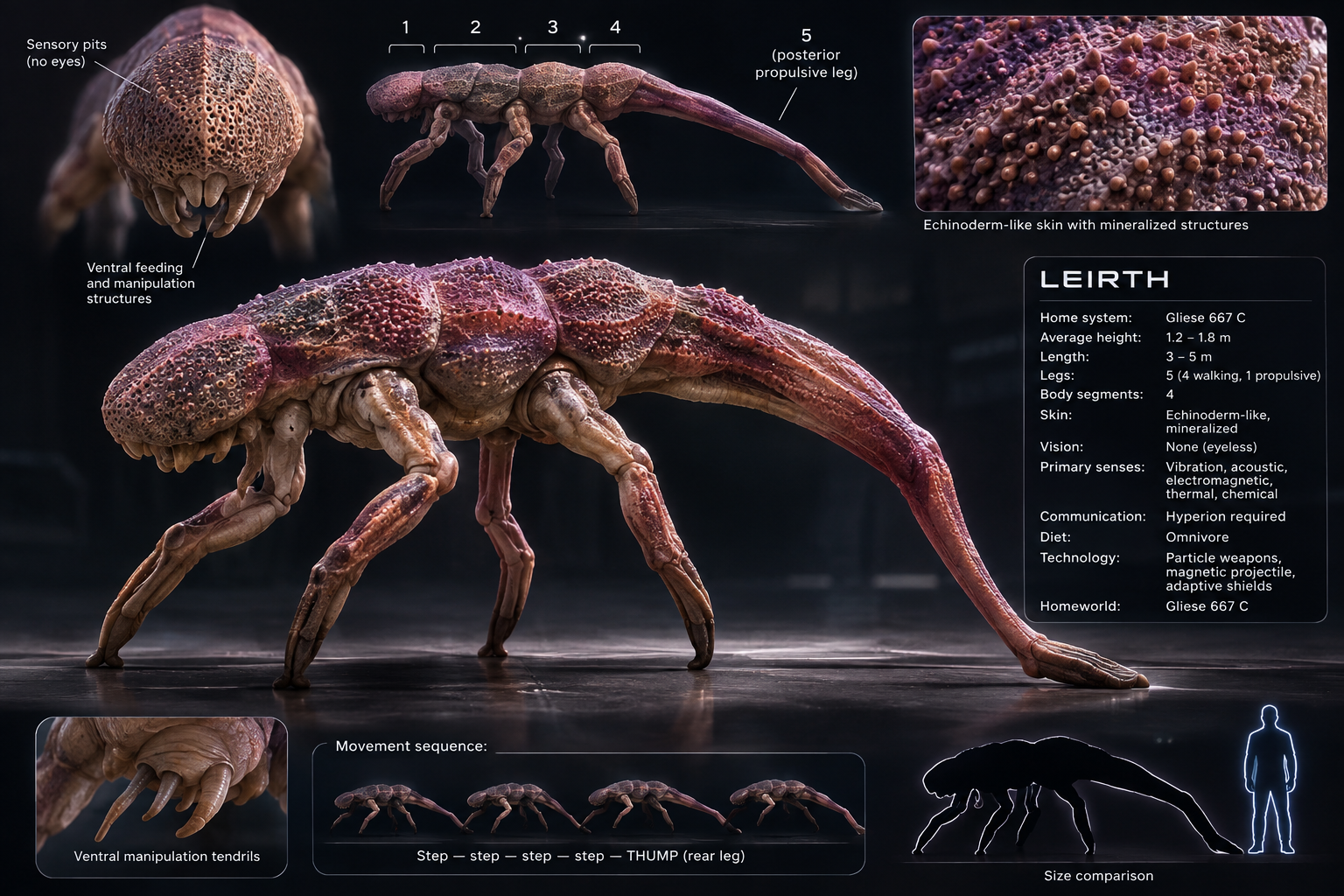
The Leirth are a technologically advanced nonhuman civilization encountered by humanity primarily around contested resource regions. Physically, they are profoundly nonhuman: they have five legs, four major body segments, no eyes, and skin described as echinoderm-like. One of their limbs is a particularly powerful posterior appendage that functions somewhat like a tail. They are also physically substantial, depicted as considerably larger than humans.
Home System
Gliese 667 C
Length
3 to 5 m
Legs
5 (4 walking, 1 propulsive)
Body Segments
4
Skin
Echinoderm-like, mineralized
Vision
None (eyeless)
Diet
Omnivore
Communication
Hyperion required
BIOLOGY
Form & Physiology
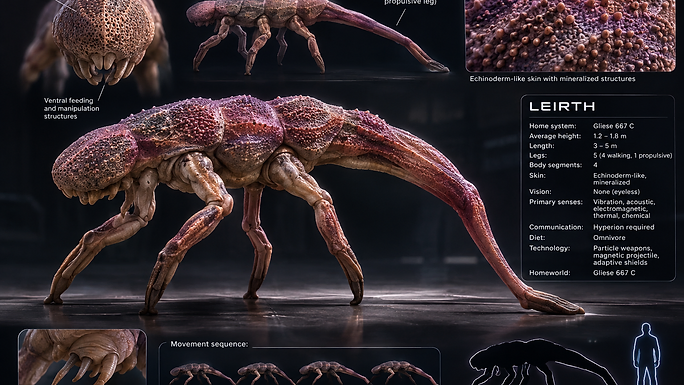
Leirth anatomy is adapted to a physically demanding environment. They have a centralized neural system, but substantial neural processing also occurs in peripheral structures distributed throughout their bodies. Their sensory apparatus integrates several different forms of environmental information simultaneously. Given that they have no eyes, their perception clearly does not correspond neatly to ordinary human vision.
They do not have a single heart analogous to a human heart. Their circulatory system instead uses multiple pumping structures. Respiration occurs through protected internal chambers that can partially seal themselves against contamination, giving them significant resistance to mineral dust and temporary atmospheric degradation. They still require an atmosphere, however, and cannot naturally survive hard vacuum.
They reproduce by producing hatchlings. Reproductive areas receive extraordinary protection, and adults demonstrate intense defensive behavior toward their young.
PERCEPTION
Sensory Apparatus
Without eyes, the Leirth perceive their environment through an integrated suite of senses that together produce a picture of the world fundamentally unlike human vision:
Vibration
Seismic and tactile oscillation detected through the body
Acoustic
Sound pressure across multiple frequency bands
Electromagnetic
Field modulation and emission detection
Thermal
Infrared and temperature-gradient perception
Chemical
Molecular and atmospheric composition sensing
THE HYPOTHESIS
Rare-Earth Elements
One of the most intriguing unresolved questions about the Leirth concerns their association with praseodymium, holmium, and samarium. Leirth activity occurs disproportionately around asteroids and moons containing these elements. Their technological importance to the Leirth is clear, but xenobiologists have proposed something considerably more significant: some rare-earth elements might also perform biological functions in Leirth physiology.
If true, it radically changes the interpretation of some human-Leirth confrontations. A human mining corporation may see an uninhabited samarium-rich asteroid as an unused mineral resource. The Leirth may perceive that same asteroid as something closer to a biologically important protected resource.
Canon does not currently establish this biological connection as confirmed fact. It remains an in-universe scientific hypothesis.
THE CORE DISTINCTION
Not Simply Enemies of Humanity
Human encounters with Leirth are frequently hostile, and many Leirth encountered by KAVOE are highly suspicious of humans. But the sources explicitly establish that this behavior is not universal.
Peaceful encounters have occurred. Some Leirth issue warnings rather than immediately attacking. Others negotiate territorial boundaries. There have been scientific exchanges, Leirth vessels have permitted damaged human ships to pass safely, and there are even limited examples of humans and Leirth cooperating against pirates.
Consequently, KAVOE doctrine explicitly teaches personnel that Leirth does not automatically mean enemy. That distinction gives them considerably more depth than a conventional hostile-alien civilization.
TWO SOURCES OF CONFLICT
Why the Leirth Distrust Humans
Resource Extraction
Human mining operations enter regions containing resources that the Leirth consider protected. Humans may not recognize a Leirth claim, while the Leirth may not recognize the human concept of mining rights. Equipment gets disabled, ships are driven away, military escorts appear, and occasionally people die.
Hatchling Poaching
There is an illegal market in which human pirates capture Leirth young and sell them as food. Among a small number of wealthy criminals and black-market consumers, Leirth hatchlings are considered an exotic delicacy. The trade is illegal throughout Consortium jurisdiction, and KAVOE has conducted operations against pirates involved in it.
From the Leirth perspective, an unidentified human ship approaching a reproductive region could literally contain members of a species whose criminals kidnap and eat their children. That provides context for behavior that humans might otherwise interpret as irrational aggression.
Interestingly, returning rescued hatchlings has produced some of the most successful human-Leirth encounters. This demonstrates that at least some Leirth distinguish humanity as a civilization from individual humans who commit atrocities against them.
MULTI-CHANNEL LANGUAGE
Communication
Talking to a Leirth is technologically difficult because their language is not simply spoken. A Leirth statement can simultaneously encode information through sound, vibration, electromagnetic modulation, timing, and pressure or physical oscillation. A human hearing only the audible component may therefore receive only a fraction of the intended message. This created serious problems during early encounters.
For example, something humans interpreted essentially as:
LEAVE
might contain additional channels communicating that the area is protected because of reproductive activity, that resource extraction must stop, and that the humans should withdraw to a particular boundary.
Humans therefore use Hyperion to communicate effectively with them. Hyperion separates the communication channels, determines how they interact, and reconstructs the information into human language. It reverses the process when humans communicate with Leirth. Even Hyperion cannot perfectly translate every Leirth cultural concept. This means some human-Leirth conflict is not merely disagreement — the two civilizations can genuinely misunderstand what they are disagreeing about.
DOCTRINE
Military Philosophy
Leirth military doctrine appears to emphasize four things: precision, adaptation, information gathering, and decisive attack. They generally do not seem interested in lengthy exchanges of fire. Their pattern is closer to:
That makes a Leirth vessel especially dangerous at the beginning of an engagement.
ARMAMENT
Weapons Technology


Adaptive Shielding
Shields analyze incoming weapons and modify themselves in response. A projectile effective once may be less effective the second time. Adaptation requires processing and redistribution, so saturating the defensive envelope with many different simultaneous threats can overwhelm the system.
Particle Weapons
Sophisticated particle weapons alter particle composition, energy, pulse duration, and possibly beam geometry. They can attack a shield, observe the defensive response, and modify subsequent attacks accordingly. Dangerous to both electronics and living organisms, with significant secondary radiation.
Magnetic Projectile
A physical projectile containing a dense, energetic non-thorium compound. After hull penetration the material disperses and undergoes a rapid reaction, producing a transient magnetic field approaching 157 teslas. It turns the interior of the enemy ship into part of the weapon.
KAVOE discovered that missile saturation is particularly effective against adaptive shielding. Simultaneously attacking many different regions of the defensive envelope with different threats can overwhelm the system's ability to adapt.
THE COPERNICUS ENGAGEMENT
The Attack on the Copernicus
The Copernicus was assigned to protect civilian asteroid miners. The humans wanted valuable materials; the Leirth wanted human mining activity stopped. The story deliberately presents the underlying problem as a clash in how the two civilizations interpret apparently uninhabited asteroids.
When a Leirth contact appeared, its first attack struck Copernicus with the magnetic weapon. The projectile penetrated and dispersed inside the ship, producing the enormous magnetic event described above. The encounter also revealed the weakness in Leirth adaptive defenses. Copernicus eventually launched more than fifty missiles. The Leirth defense system attempted to adapt to numerous detonations occurring across different portions of its defensive envelope and became overwhelmed. The Leirth vessel was destroyed.
That encounter subsequently influenced KAVOE doctrine: do not merely make the attack stronger. Give the adaptive system too many different problems to solve simultaneously. Hydra-class ships are therefore favored when serious Leirth opposition is anticipated.
Read the full story in Gem and Himari.
HUMAN RESPONSE
Countermeasures
KAVOE is developing defenses against the magnetic projectile. Experimental countermeasures attempt to detect the dispersal event immediately after hull penetration and rapidly isolate electrical networks, segment power systems, disconnect vulnerable superconducting components, activate sacrificial conductive pathways, and generate localized counter-fields to reduce the magnetic gradient. Early testing has shown some success, but protection is not guaranteed.
THE BOUNDARIES OF CANON
What We Don't Know Yet
Several major parts of Leirth civilization remain undefined or insufficiently established in the source material. Canon does not currently establish their complete governmental structure, religion, family organization beyond their protective behavior toward hatchlings, detailed reproductive biology, ordinary civilian life, lifespan, formal military ranks, or the full mechanics of their sensory organs. Their relationship with rare-earth elements is also deliberately unresolved.
Some details from generated Leirth concept art — particular dimensions, hull structures, home-system labels, and physical measurements — were produced during visual development rather than established in the prose sources and should be treated cautiously.
The strongest characterization emerging from the actual canon is this: the Leirth are a large, radically nonhuman, technologically sophisticated civilization whose apparent hostility toward humanity is partly territorial, partly the result of profound communication and cultural differences, and partly a reaction to genuine atrocities committed against their young. Their technology favors learning and adaptation rather than brute force, and their behavior shows that peaceful relations with humans are possible — even though centuries of mistrust make those relations extremely fragile.

