
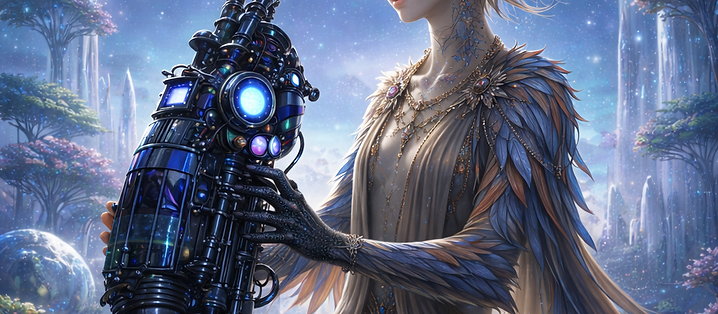
Compiled from SIAGE Archaeological Records, Procyon Belt Excavations. Lead Researcher: Dr. Sarah Fernandez, Chief of Archaeological Studies, SIAGE — Lunar Institute of Xenoarchaeology.
The Kelthorii of Ilyrion
The Vergozonth was first created by the extinct Kelthorii, a highly advanced race of musician-scientists who lived on the planet Ilyrion, which orbited the F-type main-sequence star Procyon in the constellation Canis Minor.
Procyon (spectral class F5 IV–V) emits a hotter, whiter light than Earth's Sun. The Kelthorii evolved beneath this brilliant sky, and their biology adapted to heightened photonic sensitivity. Their culture centered not on architecture or warfare — but on harmonic mathematics.
Music was not entertainment to them. It was physics.
The Kelthorii believed the universe was composed of resonant strata — layers of reality that could be influenced through precise vibrational alignment. Their civilization developed harmonic calculus centuries before combustion technology, structural resonance engineering instead of conventional metallurgy, sonic propulsion systems, and emotionally encoded symphonics. They built instruments capable of moving tectonic plates.
The Vergozonth was their masterwork — but it was not their first.
The Shovakthus: The Earliest Instrument
~63,000 – 52,000 years before the destruction of Kelnor
The earliest evidence of the Shovakthus predates the Vergozonth by more than a century and likely by several millennia in prototype form. Archaeological vaults discovered in the Heliarch Asteroid Cluster — formerly part of Kelnor's equatorial continental shelf — contained primitive instruments whose internal architecture resembles the early harmonic chambers of the Shovakthus.
These early devices appear to have been biological resonance tools, not musical instruments in the human sense. They were used to measure planetary resonance frequencies, harmonize biological breathing rhythms with planetary vibrations, and detect tectonic stress through sonic feedback.
The earliest Shovakthus prototypes were constructed from hollow crystalline reeds, braided kelthor fiber membranes, and resonance shells grown from mineral organisms native to Kelnor. These primitive instruments produced stable standing wave tones when the player exhaled through them.
Kelthorii scholars referred to this phase as The Listening Epoch. The civilization had not yet learned to manipulate resonance. They were learning to hear the mathematics of their planet.
~52,000 years before planetary destruction
The first recognizable Shovakthus emerged when Kelthorii mathematicians discovered that Kelnor's mantle produced stable harmonic oscillations. The instrument evolved into a three-part resonant device: a breath chamber similar to a harmonica mouthpiece, an air pressure reservoir similar to primitive bagpipes, and resonance tubes tuned to planetary frequencies.
The player would inhale through the central mouthpiece while a flexible resonance bladder strapped across the torso stored pressure. This allowed continuous harmonic flow without interruption. Unlike Earth instruments, the Shovakthus was not designed for melody. It produced harmonic fields — tones mathematically aligned with Kelnor's core vibration frequency.
Kelthorii temples built during this era were not places of worship. They were planetary tuning chambers. Thousands of Shovakthus players would gather to maintain resonance alignment.
The Harmonic Civilization
As Kelthorii harmonic calculus matured, the Shovakthus became central to their society. Cities were designed according to resonant geometry. Public plazas contained acoustic wells that amplified Shovakthus frequencies.
During this period the instrument gained its modern form: multi-channel harmonic reed banks, photonic crystal tuning nodes, neural biofilament straps, and spiral resonance pipes derived from Procyon's stellar oscillations. The instrument could now produce layered harmonic chords from a single breath cycle. A master player could influence atmospheric pressure currents, plant growth rhythms, and seismic tension release.
Music was no longer symbolic. It was geophysics. The Kelthorii believed their planet was alive — and the Shovakthus was how they spoke to it.
The First Philosophical Divide
Around 48,200 years before planetary destruction, a major ideological split occurred within Kelthorii society. Two schools of harmonic philosophy emerged.
The Resonant Harmonists — Shovakthus Tradition
These Kelthorii believed the universe functioned best when civilizations aligned themselves with existing cosmic vibrations. Their goal was planetary harmony, emotional equilibrium, and ecological resonance. They used Shovakthus instruments to stabilize planetary systems. Their motto appears repeatedly in excavated glyph archives: "One breath with the world."
The Harmonic Architects — Vergozonth Tradition
A more radical faction believed resonance should not merely be aligned with — it should be controlled. These researchers began developing a new instrument capable of amplifying and reshaping resonance forces. This led to the creation of the Vergozonth approximately 48,000 years ago during the era later known as The Luminous Convergence.
While the Shovakthus harmonized with nature, the Vergozonth commanded it.
Creation of the Vergozonth
The first Vergozonth was constructed during the Luminous Convergence. It was designed to amplify biological breath into structured harmonic force, translate neural impulses into tonal overlays, and bend localized gravitational harmonics through standing wave amplification.
Its curved brass body is not decorative — it reflects sacred Kelthorii spiral mathematics derived from Procyon's solar oscillation frequencies. The glowing core nodes are photonic resonance chambers containing crystal matrices grown under Procyon's ultraviolet-rich flux, capable of storing harmonic signatures of previous players.

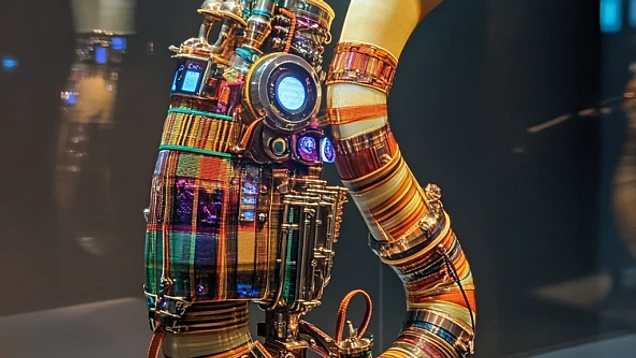
RECOVERED VERGOZONTH · SIAGE ARCHAEOLOGICAL DISPLAY · PROCYON BELT
Each Vergozonth remembers its musicians.
The instrument requires three inputs: breath as the acoustic foundation, touch for modulation through tactile harmonic plates, and intent — neural conduction via bioresponsive filaments in the strap. The shoulder strap is not for support alone — it contains conductive fibers that read subtle electromagnetic signals from the player's nervous system.
When mastered, a Vergozonth can produce multi-layered harmonic chords from a single breath, generate emotional resonance fields, shatter crystalline structures, calm violent neural storms, and alter micro-gravitational fields in a contained radius.
Untrained users hear only complex music. Trained Kelthorii reshaped matter.
The Golden Age of Dual Harmonics
~48,000 – 43,000 years before destruction
Both instruments existed simultaneously during the height of Kelthorii civilization. The Shovakthus remained the instrument of planetary maintenance, ecological harmony, and communal resonance rituals. Vergozonths were used by specialized mathematician-musicians capable of manipulating gravitational microfields, crystalline lattice structures, and emotional resonance waves.
Shovakthus players were called Harmonic Shepherds. Vergozonth players were called Resonance Architects. Despite philosophical differences, the two groups cooperated for thousands of years.
Until the Final Accord.
The Final Accord and Extinction
Records suggest that Shovakthus masters opposed the Final Accord experiment. Fragments of recovered vault tablets warn: "The world is already singing. You cannot improve a star's music by shouting into it."
But the Vergozonth architects believed planetary-scale resonance alignment with Procyon could elevate their civilization to a new state of existence. The Kelthorii attempted to synchronize Ilyrion's core resonance with Procyon's stellar oscillations. The result was a catastrophic resonance cascade. Ilyrion fractured. The Kelthorii were lost.
Only a handful of Vergozonths survived, ejected into deep space by the harmonic shockwave. The Shovakthus tradition continued up until the moment of catastrophe. Excavated stasis vaults contain hundreds of preserved Shovakthus instruments, carefully stored alongside harmonic archives — suggesting the Kelthorii expected future civilizations to rediscover them.
Effects on Human Players
If a human has been playing a Vergozonth for months, the effects would not be purely musical. They would be neurological, physiological, and possibly cosmological.
The Vergozonth's strap filaments read and subtly amplify neural electromagnetic signals. Over time, this causes increased cross-hemisphere brain synchronization, heightened pattern recognition, enhanced mathematical intuition, and stronger emotional-cognitive integration. After months of exposure, the player may perceive harmonics in everyday sounds, "see" patterns in architecture, speech rhythms, and even star maps, and experience synesthetic blending — sound as color, emotion as vibration. Brain scans would likely show unusually coherent gamma-wave activity.
The instrument doesn't just translate emotion. It feeds it back. A human player may experience intensified empathy, deeper emotional states, difficulty suppressing feelings, and strong emotional bonds formed quickly. Positive emotions become radiant. If the player performs while angry or grieving, the harmonic output can distort the local environment — vibrating glass, flickering lights, electronic interference.
Prolonged resonance exposure may begin altering the body at a micro level. Possible effects include increased lung capacity, enhanced fine motor control, slight elevation in baseline body temperature, and greater tolerance to ultraviolet radiation. Some players report feeling physically "lighter," as if gravity fluctuates slightly during performance. The Vergozonth produces localized micro-gravitational perturbations.
This is where it gets dangerous.
Silence becomes uncomfortable. The player feels "misaligned" without resonance. Ordinary music sounds flat and incomplete. Withdrawal symptoms could include irritability, loss of emotional control, auditory hallucinations of faint harmonic chords, and phantom vibration sensations.
The Vergozonth stores harmonic memory from prior Kelthorii musicians. Long-term human players may begin to dream in unfamiliar harmonic languages, hum melodies they never consciously learned, experience flashes of alien starfields, and feel emotional echoes that aren't their own. The instrument does not possess consciousness — but it carries harmonic imprint.
If the human achieves high harmonic coherence, objects may subtly vibrate in tune nearby, biophysiology harmonizes with local stimuli, small fractures may form in crystalline materials, electromagnetic devices may desynchronize, and animals may react strongly — either drawn or distressed. At extreme levels, the player could accidentally trigger a localized resonance cascade — a miniature version of the Kelthorii catastrophe.
The Three Outcomes
Most humans fall into one of three categories:
- The Harmonized — Calm, perceptive, almost luminous in presence.
- The Fractured — Overstimulated, emotionally unstable.
- The Conductor — Rare individuals who begin intentionally shaping resonance fields.
Modern Discovery and Current Status
Modern human exploration of the asteroid belt revealed intact Kelthorii harmonic temples, sealed musical vaults, and stasis-protected Shovakthus instruments. Many still contain encoded harmonic signatures of their last players. When tested in laboratory conditions, the instruments produce extremely complex wave patterns that appear to interact with electromagnetic fields. However, no human has yet demonstrated full compatibility.
Dr. Sarah Fernandez proposes the following interpretation: the Shovakthus was never designed as a weapon or a machine. It was a planetary conversation device. The Kelthorii did not dominate their world — they played with it. When the Vergozonth architects attempted to synchronize Kelnor's core with Procyon's stellar oscillations during the Final Accord, the resonance cascade shattered the planet. Ironically, the oldest instrument of their civilization — the Shovakthus — had always warned against such imbalance.
Recovered Shovakthus instruments are currently stored in secure SIAGE facilities. Most are dormant. But several have produced weak resonance responses when handled by certain humans — particularly those exhibiting high mathematical intuition, strong emotional empathy, and unusual breath control.
In the current era, Vergozonths are extremely rare, often mistaken for decorative steampunk artifacts, incredibly dangerous in the wrong hands, and nearly impossible to fully activate without Kelthorii-level harmonic cognition. However, some humans exhibit partial compatibility — especially those with heightened mathematical intuition and emotional intensity.
Researchers remain cautious. The Kelthorii did not destroy themselves through violence. They did it through perfectly calculated music.

