
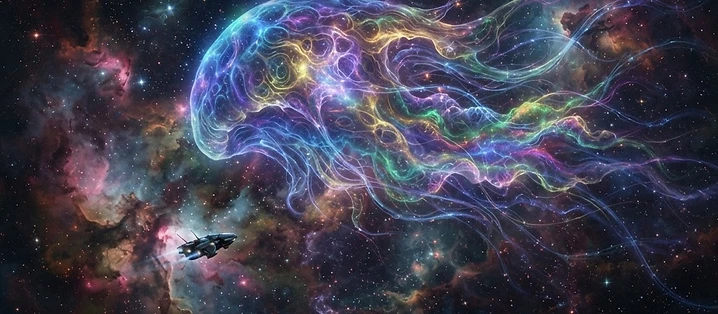
Velor John Andelian had been aboard the Kraken-class Calypso for less than six hours when he received his first order concerning a Leviathan. It was not the order he expected. "Don't look at it."
Don't Look at It
Leviathan Defense — KOA LD-63 — did not mean defense from Leviathans. Sometimes it did. But it also meant defending Leviathans: from poachers, disease, collisions, industrial contamination, frightened colony governments, and occasionally from KAVOE itself. Kraken-class vessels existed in the uncomfortable space between military operations, veterinary medicine, and disaster response.
The organism was Perditor Voraxis — an Amoeboid Nebular Leviathan, approximately two hundred thirteen kilometers across. No fixed morphology, no skeleton, no conventional organs. The civilian xenobiologist Kari Heather Lithgo explained: the Perditor had no eyes, no brain, no nervous system in the familiar sense — just neurons suspended through a cytoplasm-like conductive medium, densest near the center. Solari Jaburri Seztwana gave the operational explanation: "I look beautiful. I make you feel good. Don't kill me."
The light was a defensive adaptation against higher-order cognition. Exposure created calm, affection, protective impulses. "Mind control?" "No." "Hypnosis?" "Closer." "Imprinting?" "That's the word crews use." Seztwana's first rule: never allow the organism to participate in the decision about what to do with it.
The Light
On the first external operation, John's curiosity became unbearable. What could possibly be so beautiful that KAVOE had procedures telling people not to look? He manually reduced the filter. Color entered. The Perditor glowed — not one color, thousands. Blue became violet. Violet fractured into threads of gold. Green appeared deep within and spread outward like dawn through an ocean. It was beautiful. Warm. Safe. Looking at it felt like remembering something good from childhood he could no longer name. "Why would anyone hurt this?"
"FILTER." Kari's shout broke through. John restored it. Gray returned. The emotional effect did not. His heart hurt with the sudden absence of the colors. Seztwana reprimanded him. "Was it worth it?" John remembered the light. "Yes." Wrong answer. At the door, she spoke again. "That feeling isn't yours." "It feels like mine." "That's why we have the order."
The Order
For eleven months, NB-09 had migrated through a nutrient-rich nebula, filtering and absorbing. The process was completely natural. It was also destroying the region. Food webs collapsed. Two microbial populations fell below recovery thresholds. Photon lures, chemical attractants, physical redirection — the Perditor followed, then went back. Seztwana convened the command group. "We've received authorization for lethal intervention." John stared. "No."
Seztwana's voice hardened. "Leviathan Defense does not mean Leviathan worship. Our responsibility is ecological balance. Sometimes that means protecting the organism. Sometimes it means protecting everything around it." John sat at the tactical station. NB-09 appeared as geometry. Range. Mass. Target zones. No colors. No beauty. Just numbers. "Fire." John stared. Don't kill me. "Velor." He didn't move. "Fire." John looked at her. "No." Security approached. As they led him away, he looked toward the filtered viewport. He still remembered every color.
The Mermaid
Kari had an idea. A modified Madori-wave device — KDEL-672-GX — to suppress the feeding pattern by stimulating the dense central neural concentration. "You're going to hypnotize the thing that hypnotized me." Kari smiled. "That's an offensively simplified description." "Is it wrong?" "No." The plan: take a Mermaid craft inside the Perditor, attach the KDEL near the center, suppress feeding, redirect NB-09 away from the depleted region. Seztwana told John: "This is your second chance. Not your exemption from duty." If it didn't work, he would carry out the lethal order himself.
The Mermaid entered through a temporary intake pore. The interior resembled an ocean made from translucent living gel. Filtration membranes stretched for kilometers. Neurons flickered within the cytoplasmic medium like tiny stars. John deployed the KDEL. The Perditor convulsed. For several terrifying seconds he could see nothing except luminous biological material. Then the pressure relaxed. Feeding rate dropped — forty percent, then sixty. The Perditor began to move. Away from the depleted region. Toward the lure corridor. "It's following!" John closed his eyes. "We did it."
The feeling lasted eleven minutes. Then the neuronal lights began disappearing. One by one. Then hundreds at once. The great filtration membranes stopped moving. The light faded. "Get out." "No." "John, you need to leave now." He remembered the brig. He remembered what Seztwana had said. Compassion did not give him command authority. "Yes, Solari." The Mermaid emerged through an intake pore that would never open again.
The Filtered Viewport
NB-09 died without exploding. Its body remained largely intact, allowing containment. The surrounding ecosystem would probably survive. The mission, according to several official criteria, had succeeded. John sat in the observation compartment. Kari entered and sat beside him. "We killed it." "Yes." "I killed it." "We don't know that." "I attached the device." "I designed the intervention." "Don't."
"It was beautiful." "I know." "Have you looked?" Kari hesitated. Then nodded. "Once." "When?" "Years ago." "What did you feel?" She thought. "Safe." John nodded. "That's it." Kari's eyes became wet. "It wasn't actually telling you anything. The light was probably automatic. Evolution." John looked back toward the Perditor. "That doesn't make it less beautiful." "No." Eventually Kari reached over and put her hand on his. "You tried." John stared at the enormous dead organism beyond the filtered glass. "Does that matter to it?" Kari had no answer. Neither did John.
Several days later, at a KAVOE transfer station, John met a First Lancer reading something legal — Shirley Q. Perrymane, a Jurisar. "I just spent several days arguing about whether something deserved to die." Shirley's expression changed slightly. "Did it?" "That's the problem." Inside her case were the records from Ulosheen. Two sectors. Hundreds dead. Seven survivors. And the testimony of a KAVOE Thalon who insisted he had ordered the deaths because the people inside those sectors were becoming something that was no longer human.
The story continues in “Ulosheen.”

