
SPECIES · THE ETERNAL RECORD KEEPERS
Velkth
An Ancient Civilization Devoted to the Preservation of History
The Velkth are an extraordinarily ancient, technologically advanced civilization whose defining cultural principle is not conquest, wealth, territorial expansion, or even scientific advancement. It is memory. Their civilization is built around the conviction that civilizations die, species disappear, languages vanish, and even stars eventually cease to exist — but an accurate record can survive. Consequently, the preservation of history isn't merely an academic profession among the Velkth. It is a civilization-wide moral obligation.
History belongs to everyone.
Their reputation has become so strong that an interstellar saying holds that if the Velkth recorded something, it happened. Governments consult their archives during treaty disputes and historical controversies because Velkth records can extend vastly farther into the past than those of younger civilizations.
Homeworld
Velk'thar
Government
The Grand Archive
Capital
The Infinite Repository
Height
~6'8" to 7'8"
Longevity
Thousands of years
Traditional Faction
Iyuthe'
Renegade Faction
Lorekgeen
Highest Office
First Archivist
BIOLOGY
Physical Appearance
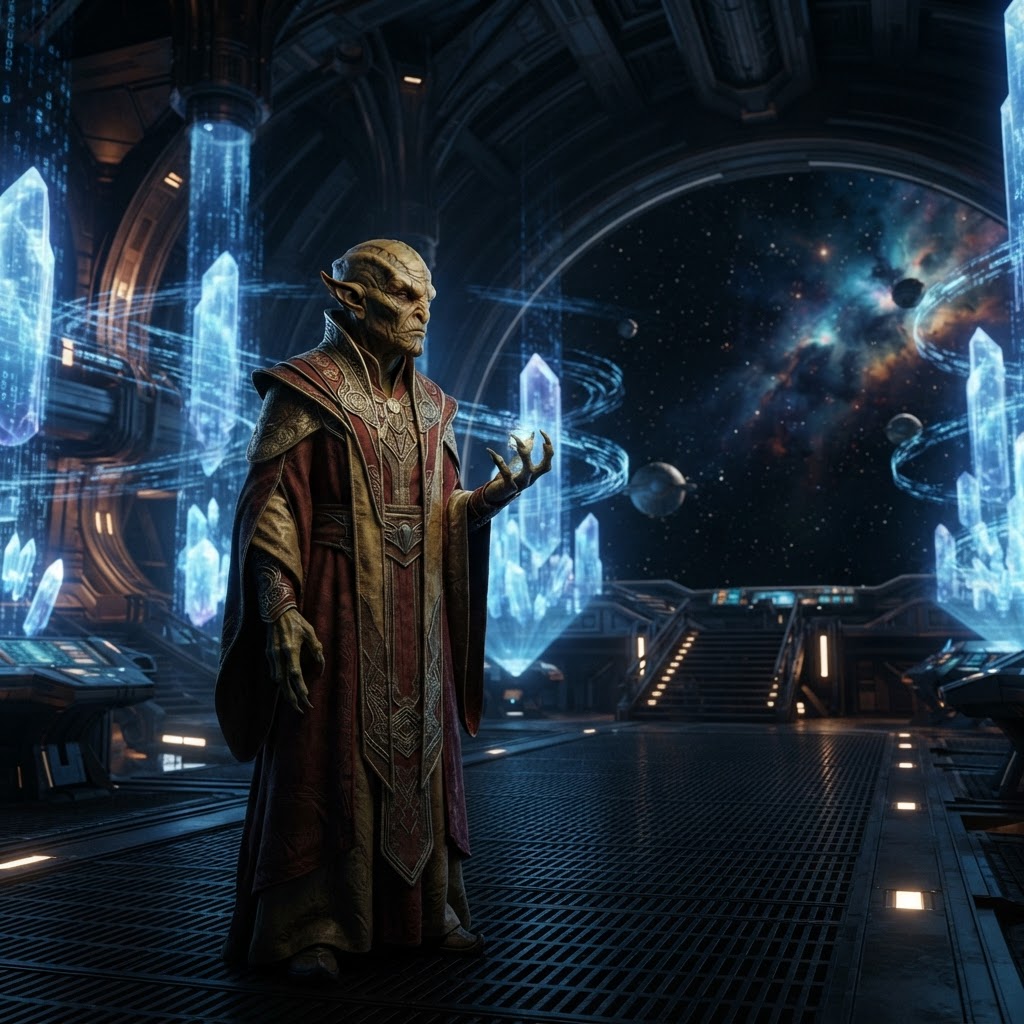
Velkth are tall humanoid aliens, but they're readily distinguishable from humans. Most Velkth have olive to emerald skin, elongated skulls with pronounced cranial ridges, narrow eyes, elongated ears, and four nostril slits instead of a conventional human nose. Their hands possess six fingers and exceptional dexterity.
Their movements tend to be deliberate rather than hurried, and their voices are characteristically soft and measured. They generally avoid interrupting other speakers. Humans can initially interpret this restraint as aloofness or arrogance, but it is more characteristic of Velkth social behavior than hostility.
Their typical height is roughly 6 feet 8 inches to 7 feet 8 inches, making most Velkth noticeably taller than humans.
BIOLOGY
Three Mating Types
Velkth reproductive biology is one of their most unusual established biological characteristics. They don't possess two reproductive sexes analogous to the standard human system. Instead, there are three mating types:
Welthul
Contributes approximately half of the offspring's genetic material. Closest analogue to a human female.
Jylthul
Contributes the complementary genetic sequence. Closest analogue to a human male.
Eloth
Serves as the biological incubator. After fertilization, developing embryos are transferred to an Eloth, who normally carries three or four offspring simultaneously.
This has profound cultural consequences. A Velkth family is biologically dependent upon all three mating types, and Velkth society therefore accords equal cultural importance to all three. None is regarded as biologically or socially superior.
We should be careful about translating these categories simply as "female, male and incubator." Those are human approximations. Welthul, Jylthul and Eloth are the canonical Velkth categories.
BIOLOGY
Extraordinary Longevity
Velkth age extremely slowly. Many live for several thousand years. Consequently, humans can encounter Velkth individuals whose personal memories extend into periods that human historians consider ancient history.
That gives their civilization a very different relationship with history. For a human historian, a thousand-year-old event requires archaeology and documentary evidence. For a sufficiently old Velkth, parts of that same period could conceivably involve someone's personal memories or accounts received directly from individuals who lived through it.
The source notes speculation that Velkth longevity may somehow relate to the ancient event involving their lost or original homeworld. Canon does not currently establish this connection.
CULTURE
A Civilization Built Around History

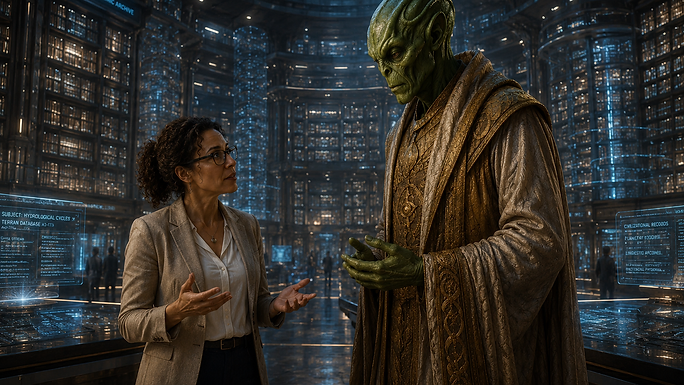
Every Velkth is expected to contribute to historical preservation in some capacity. Their society includes enormous numbers of historians, librarians, archaeologists, linguists, anthropologists, treaty archivists, memory curators, cultural observers and diplomatic recorders. Velkth children begin maintaining historical journals shortly after learning language. By adulthood, many have already written dozens of scholarly works.
This doesn't mean every Velkth spends life sitting in a library. Quite the opposite. They travel extensively because living cultures are part of history. A Velkth researcher might spend months eating local food, attending concerts, watching sports, riding public transportation, attending weddings, interviewing cooks or recording slang. Humans may think the Velkth is on vacation. The Velkth thinks they're doing fieldwork.
That fits their broader characterization: history isn't merely kings, wars and governments. Ordinary daily life is something worth preserving too.
INFRASTRUCTURE
The Velkth Archives
The Velkth maintain what the sources describe as the greatest archival network in known space. Their libraries exist on inhabited planets, orbital stations, beneath planetary surfaces, inside artificial moons, and even in neighboring galaxies. Other governments sometimes voluntarily provide territory for Velkth archives because having one benefits everyone.
The archives use redundant crystalline memory systemsintended to preserve information for millions of years. Some archive complexes have grown so large that they effectively function as cities.
THE CENTER
The Grand Archive
At the center of this network is the Grand Archive within Velk'thar. It is described as perhaps the greatest single repository of information ever constructed. Rumored holdings include extinct languages, lost musical traditions, ancient diplomatic records, prehistoric star charts, biological records of extinct organisms, and firsthand observations of civilizations that younger species know only through archaeology or mythology. Some Velkth themselves reportedly haven't explored its entirety.
The source describes some of these specific holdings as rumors. What is established is that the collection is extraordinarily old and enormous — not that it definitively contains every lost language or every vanished species.
THE IMPOSSIBLE WORLD
Velk'thar
Velk'thar may be the greatest technological mystery associated with the species. From outside, it appears to be a gas giant completely enclosed by a perfectly smooth metallic sphere. At first glance, human scientists apparently mistook the structure for something resembling a Dyson sphere — but Dyson spheres surround stars. Velk'thar's shell surrounds a planet.
Even more strangely, the structure reportedly emits energy on a scale comparable to stellar output. Contemporary human physics cannot adequately explain the phenomenon. The shell also appears effectively indestructible. Weapons, mining lasers, antimatter devices and Vertikron cannons have failed to visibly damage it.
When questioned about how the structure was constructed, the Velkth respond:
Some histories are earned.
THE MYSTERY
The Lost Homeworld
There is evidence suggesting that Velk'thar may not actually be the Velkth's original homeworld. The Velkth maintain that Velk'thar has always been their home. Yet archaeological records recovered from multiple extinct civilizations — including the ancient Kelnorii — apparently refer to another Velkth civilization that disappeared before recorded history.
One prevailing hypothesis is therefore that the original Velkth homeworld was destroyed or otherwise lost. The Velkth won't confirm it. They won't deny it either.
Canon does not currently establish what happened to the original Velkth world — or definitively establish that another homeworld actually existed.
DEEP HISTORY
The Kelnorii Connection
The Velkth are ancient enough to have interacted directly with the Kelnorii. Authentic treaties bearing Velkth seals establish diplomatic relations between the civilizations. This means the Velkth were already an advanced interstellar civilization while the Kelnorii were active.
That dramatically extends their historical importance. The Velkth didn't merely discover Kelnorii ruins later. They knew them. Which raises an obvious question: how much do the Velkth know about other ancient civilizations? They aren't telling everyone.
ARCHAEOLOGY
Humans Trying to Get Their Records
This creates an interesting relationship with human archaeologists. Human historical organizations have spent centuries trying to verify rumors concerning the original Velkth homeworld, with little success. The Velkth recognize the legitimacy of human archaeology but are frustratingly selective about information.
Requests can take years. Some expeditions have waited decades. Certain documents require unanimous approval by Velkth elders. Other archives remain permanently sealed.
Yet Velkth observers sometimes appear at human archaeological excavations. Usually they simply watch. Occasionally one quietly directs researchers toward an overlooked ruin. Sometimes a Velkth apparently examines what humans have found and leaves — suggesting the humans aren't yet ready for whatever is there. This has produced an archaeological joke:
If a Velkth shows up, you've found something important.
POLITICS
Government
Velkth government is closely integrated with their archival philosophy. They are governed by the Grand Archive, described as a council of historians rather than conventional politicians or military leaders. The highest office is the First Archivist. Authority is supposedly earned through scholarship, accuracy and service. Historical integrity is regarded as a central qualification for political authority.
A named First Archivist appearing in the developed lore is Vael'Kor Ithuun.
Exactly how members of the Grand Archive are selected, how long they serve, whether local governments exist, and how executive authority functions outside archival matters remains insufficiently developed.
SOCIETY
Law and Crime
Crime among mainstream Velkth is described as exceptionally uncommon. When traveling, they generally obey local laws and customs even when they disagree with them. If a local law fundamentally conflicts with their principles, they are more likely to leave the jurisdiction than violate the law or openly provoke confrontation.
Their reputation for accuracy and honesty is so strong that Velkth testimony is considered particularly reliable in many interstellar courts. But Velkth society isn't crime-free. That brings us to the Lorekgeen.
THE TRADITION
Iyuthe': The Traditional Velkth
The Iyuthe' represent traditional Velkth civilization. Their fundamental belief is that history must be preserved accurately, including events that are embarrassing, painful or politically inconvenient. Their creed is summarized as:
Truth survives because someone remembers.
Nearly every Velkth normally encountered by humans belongs to this tradition.
THE RENEGADES
Lorekgeen
The Lorekgeen reject the central Velkth principle that history belongs to everyone. Instead, they believe information itself is power and should be controlled by those capable of wielding it. Lorekgeen may destroy historical records, rewrite them, or hoard restricted knowledge for personal advantage.
To mainstream Velkth, this isn't ordinary vandalism. It is something approaching a civilization-level moral atrocity. Destroying history effectively robs every future generation of the truth. Consequently, the Lorekgeen represent one of the greatest internal threats to Velkth civilization.
CAPABILITY
Technology
Velkth technology is extraordinarily advanced. Known or attributed capabilities include self-repairing megastructures, quantum memory crystals, dimensional archival storage, gravity-based transportation, extremely sophisticated translation systems, and biological preservation systems capable of preserving organisms from extinct species.
The technological gap between Velkth and humanity is particularly apparent in their spacecraft.
VESSELS
Velkth Starships
Velkth spacecraft are described as perfect spheres. They have no visible bridge, no windows, no engines, no seams, and no visible weapons. Their hull material resembles the apparently indestructible material surrounding Velk'thar. Despite the absence of recognizable propulsion machinery, these vessels maneuver with extraordinary precision.
This is consistent with another established point in the broader universe: human sensors cannot determine how Velkth propulsion works. The propulsion system is effectively unknown and undetectable by current human understanding. That is an important distinction from simply saying "the Velkth have a better Gorbillian drive." We do not know that they use Gorbillian propulsion at all.
PARADOX
Weapons — or the Lack of Them
Traditional Velkth refuse to manufacture offensive weapons. Their vessels consequently don't display recognizable armaments. Yet their technological capability is so advanced that military analysts apparently consider the theoretical prospect of a hostile Velkth civilization extremely dangerous.
This creates an interesting distinction: The Velkth aren't peaceful because they're technologically incapable of violence. They appear peaceful despite possessing technology that could make them extremely difficult to oppose.
Exactly what defensive systems their ships possess is not adequately established.
SCIENTIFIC INFLUENCE
Orphetuology

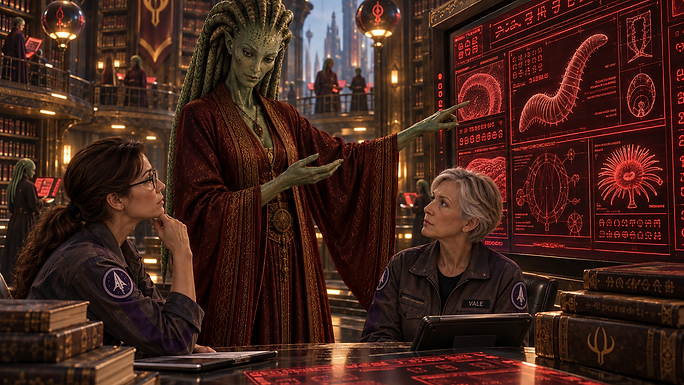
Modern human Bioxenology/Orphetuology is derived from Velkth scientific thought. Marissa Edgington is explicitly described as an Orphetuologist using newer Velkth-derived terminology. Her entire Sectors 1–7 expedition is designed to apply this framework systematically to alien ecosystems.
The system comes from harmless Velkth texts donated by Velkth elders. That's significant because it shows the Velkth don't simply hoard information. They selectively share it.
METHODOLOGY
How Velkth Classification Differs from Earth's
Traditional Terran taxonomy begins primarily with ancestry: What is this organism related to? The Velkth-derived approach starts elsewhere: What does this organism do?Specifically, it examines how an organism obtains energy, interacts with its environment, and organizes its living structure.
That makes much more sense when comparing completely unrelated extraterrestrial biospheres. A six-legged feathered organism that produces milk and lays external eggs shouldn't be forced into the human categories "bird" or "mammal." The Velkth framework classifies its actual biological and ecological function.
TAXONOMY
The Five Primary Feeding Types

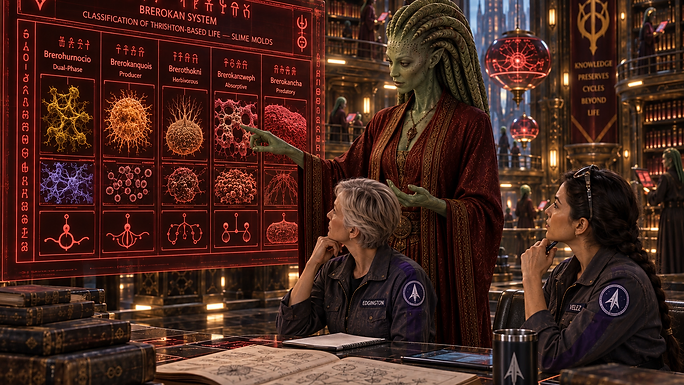
The Velkth-derived system currently recognizes five major feeding strategies:
Brerokantha
Killer-feeders that obtain biological energy by killing and consuming organisms.
Brerokanquois
Self-producers that manufacture usable biological energy from nonliving energy sources.
Brerokanzwoph
Absorber/filter-feeders.
Brerothokni
Living-tissue grazers that consume or harvest living biological tissue without necessarily killing the organism.
Brerohurnocio
Light-shift organisms that behave as producers under sufficient illumination but become consumers or predators under darkness or prolonged low-light conditions.
FIELD APPLICATION
The Velkth Influence in the Expedition
Phase III contains a particularly revealing statement. After encountering multiple alien parasites, Marissa writes:
I am beginning to appreciate the elegance of the Velkth decision to classify parasites by what they do rather than by what they resemble.
That sentence captures the practical success of Velkth biological philosophy. Across Phases III–V, Marissa repeatedly encounters organisms that visually resemble one category but function ecologically as another. A stationary organism becomes mobile. A "plant" becomes a predator at night. A seemingly predatory organism turns out to be a parasite. Seven apparently separate organisms turn out to constitute one distributed consciousness.
The Velkth system survives these discoveries better than an Earth-centered morphology-first classification scheme precisely because it was designed for alien life rather than terrestrial familiarity. Phase V explicitly concludes that classification categories are tools rather than commandments and must remain revisable when nature contradicts them.
That gives us a deeper insight into Velkth intellectual culture. Their biology system reflects their broader philosophy: Record what actually happened. Preserve mistakes. Revise when evidence demands it. Don't erase an uncomfortable earlier conclusion simply because a better one replaced it.
RELATIONS
Humanity and the Velkth
Human-Velkth relations are generally described as exceptionally warm. Humans tend to admire their honesty, courtesy, historical knowledge and intellectual curiosity.
But "warm" doesn't mean unrestricted access. The Velkth can be friendly while still refusing to answer a question for decades. That's an important part of their personality as a civilization.
A NOTABLE RELATIONSHIP
Kaitlyn Marks
The most famous intimate human-Velkth relationship currently established involves Kaitlyn Marks, identified as the first known human to marry a Velkth. For decades after the marriage, Kaitlyn reportedly appeared to age extraordinarily slowly. Then, in 2117, she disappeared. There was no evidence of foul play. The Velkth acknowledged that she had disappeared but refused to explain what happened.
There are theories that she was allowed to live within Velk'thar or received unprecedented access to the Grand Archive. Canon does not currently establish this. Kaitlyn's apparently slowed aging is also intriguing, but we shouldn't automatically conclude that the Velkth altered her biology.
PHILOSOPHY
Their Greatest Contradiction
The Velkth believe: History belongs to everyone.Yet they also maintain sealed archives, withhold information, deny access, and sometimes require civilizations to prove themselves ready before certain knowledge is released.
That isn't necessarily a continuity contradiction. It appears closer to a philosophical tension inside their civilization. They believe history should survive. That doesn't necessarily mean every civilization is entitled to every piece of information immediately.
The Lorekgeen resolve that tension by saying knowledge belongs to those powerful enough to control it. The Iyuthe' apparently resolve it by saying knowledge must be preserved accurately, while dangerous or consequential knowledge can sometimes remain restricted. That distinction could become one of the richest elements of Velkth culture.
THE BOUNDARIES OF CANON
What the Sources Do Not Establish
There are still substantial open areas. Canon does not currently establish their precise evolutionary origin, original homeworld, mechanism of extreme longevity, full internal anatomy, exact population, detailed dietary requirements, complete language, religion, economic system, currency, everyday architecture, mechanism of their propulsion, mechanism powering Velk'thar, construction method of its shell, full defensive capabilities, or exactly what happened to Kaitlyn Marks.
The developed Velkth profile itself says that it "expands upon established canon." Details such as The Infinite Repository, exact average height, the formal names Iyuthe'/Lorekgeen, and some specifics of Velk'thar should be treated as developed lore pending explicit ratification before being elevated to hard canon.
What is most consistent across all the material is this: The Velkth are an ancient, extraordinarily long-lived, technologically superior civilization devoted to preserving information across deep time. They don't conquer younger civilizations. They study them, visit them, record them, and preserve their histories. Their biological science has become influential enough that a human scientist such as Marissa Edgington uses a Velkth-derived system to classify organisms across completely unrelated biospheres. Their archives may contain eyewitness records of civilizations humanity knows only from ruins. Their ships move through space using technology humans cannot identify. Their supposed homeworld is itself a technological mystery.
And perhaps most characteristically: they know far more than they are willing to tell us.

