
OCTOBER 2365 \u2013 12 JANUARY 2366 \u00B7 AET 04673M
Phase V A World Without a Sun
A rogue planet, a distributed consciousness, and the sixth presence.
After Aglaea, the expedition became quieter. Not safer. Quieter. Nobody celebrated a routine landing anymore. They checked seals, scanned the ground, verified local organisms, checked one another for attachments, and then checked again. The Gulliver had become less like a vessel and more like a moving habit.
The late-system surveys confirmed the central value of Orphetuology. Unrelated organisms repeatedly converged on the same ecological jobs. There were grazers with shells, grazers with fur-like filaments, grazers that rolled, and one grazer that spent most of its life hanging upside down beneath a floating producer mat. There was no universal body plan. There was no cosmic cow. There was a cosmic job performed by things that do what cows do.
Rogue Planet RP-7-2365
KAVOE approved a limited escort for the rogue-planet objective. Their job was transit security, emergency extraction, and response to hazards beyond the reasonable capability of a civilian survey vessel. Marissa Edgington remained expedition lead.
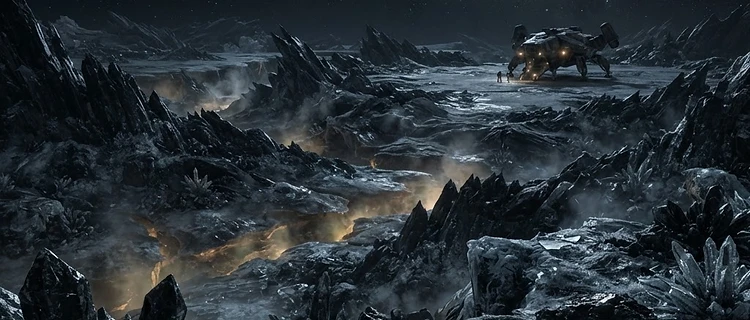
There was no sunrise. Marissa knew intellectually what a rogue planet was. She had seen simulations, remote images, and HEILO reconstructions. None of those prepared her for standing beneath a sky with no star in it. The darkness was not night because night implies morning. Above them were distant stars, but none belonged to the world beneath their feet.
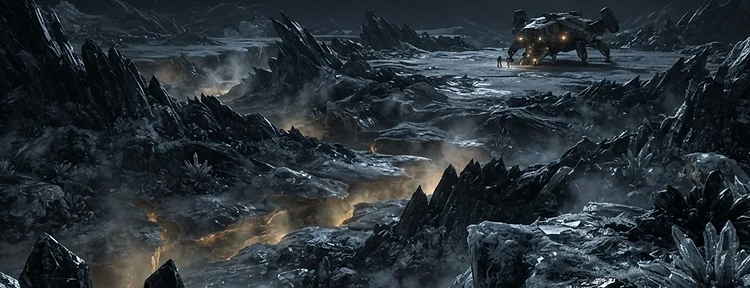
The surface was a broken plain of black mineral ridges, frozen volatiles, crystalline growths, and shallow valleys where geothermal and Thrishton-associated anomalies produced localized warmth. The first living thing they confirmed was stationary. The second was not. The most important producers were Quoithris forms: organisms obtaining usable metabolic energy by reducing local Thrishton stress points. Their energy source would have seemed impossible to an earlier Terran botanist. The food web began there.
Scatterglass
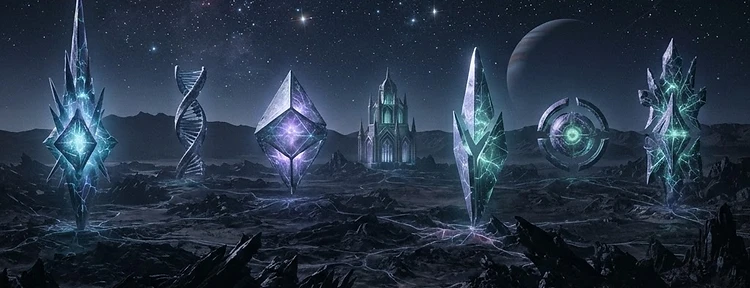
Scatterglass was Marissa's worst classification error and her favorite discovery. They first catalogued seven crystalline structures across a twelve-kilometer field. Their shapes differed enough that Sabrina proposed three species. Marissa proposed two. Quincy suggested that one was geological and should not be in the registry at all.
Patrick ruined the taxonomy by moving a sample marker. He relocated one marker beside Structure Four. Structure Seven, twelve kilometers away, changed its orientation within seconds. They repeated the disturbance. The response repeated. Over four days they tested vibration, radio, thermal pulses, chemical release, light, ground conduction, and every conventional communication mechanism their field equipment could assess. They found no signal traveling between the structures fast enough to explain the coordination.
The seven bodies were not seven organisms. They were one.
FIELD REVISION 5-02 Scatterglass
Initial: Multiple Quoithris organisms, possibly two or three species
Revised: One Discoran individual, Brerokanquois › Quoithris
Components: Seven major bodies plus at least nineteen minor fragments
Conscious identity: Singular to the limits of current testing
Coordination mechanism: Unknown
"I will not write 'telepathy' in the scientific classification. The word names our ignorance more effectively than it names a mechanism."

The Sixth Presence
The sixth discovery began when a sample case moved. No one was touching it. The case slid approximately eighteen centimeters across a level laboratory platform and stopped. GIORODVA confirmed that the Gulliver had not accelerated. Patrick checked the surface. No mechanical cause was found.
The next incident occurred outside. Bethany saw what she described as a distortion between two ridges, like an object viewed through moving water. Quincy saw nothing but heard three irregular sounds. The instruments recorded nothing. The phenomenon did not correspond to any organism in the registry, any known physical effect, or any instrument artifact the crew could reproduce.
The expedition departed RP-7-2365 on 12 January 2366. The sixth presence was recorded in Appendix C under "Unresolved Phenomena." Marissa's final journal entry for the survey read, in full: "We came to classify the unknown. We leave having met something that does not wish to be classified. This is not a failure. This is the correct outcome of honest fieldwork."
Five Organisms of RP-7-2365
| Organism | Classification | Field Observation |
|---|---|---|
| Stressbloom | Brerokanquois > Quoithris | Crystalline producer growing around Thrishton stress gradients; releases heat and organic nutrient films. |
| Shard Grazer | Brerothokni > Thokgra | Low, armored mobile consumer scraping nutrient films from Stressblooms. |
| Night Hook | Brerokantha > Kanthask | Slow ambush predator hiding among crystal ridges and striking passing Shard Grazers. |
| Black Sieve | Brerokanzwoph > Zwophfil | Subsurface filterer drawing mineral-rich brine through porous feeding plates. |
| Scatterglass | Discoran + Brerokanquois > Quoithris | Crystalline distributed organism composed of physically detached components sharing one consciousness. |
Reader Discussion
0 comments
No comments yet. Be the first to discuss this story.

