
TECHNOLOGY · CIVILIAN SERVICE ROBOTICS
Civilian Service Robotics Reference
Nadels, Wendrules & the Intelligence Hierarchy
Intelligence Hierarchy
This distinction is important legally and culturally. A Nadel saying, “You seem a little down today, Steven. Would you like your usual?” is performing sophisticated behavioral analysis. A Senticom saying the same thing may actually care whether the person is unhappy.
Jaykes and Jaynes occupy the difficult territory immediately below that threshold. They can demonstrate extraordinarily sophisticated reasoning, conversation and behavioral adaptation but are not legally or scientifically classified as conscious.
Nadel
AUTONOMOUS HOSPITALITY SERVICE ROBOT
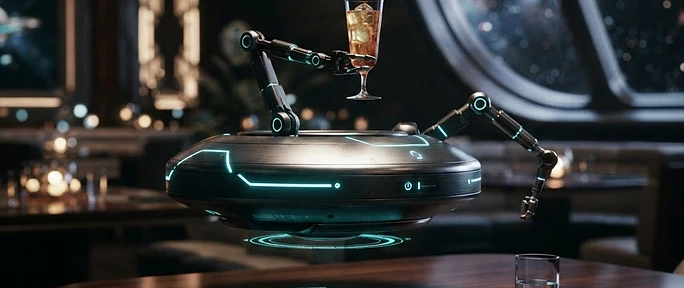
Nadels are disk-shaped flying service robots primarily designed for restaurants, bars, hotels, passenger vessels, entertainment facilities and other hospitality environments. Their articulated arms allow them to carry food, beverages, utensils and other service items while their flight systems allow them to pass above tables and furniture.
They are deliberately designed as hospitality machines rather than artificial people.
Physical Specifications
- TYPICAL DIAMETER
- 55–75 cm
- TYPICAL THICKNESS
- 20–30 cm
- ARMS
- Usually 3–4 retractable articulated manipulators
- SUGGESTED MAXIMUM SPEED
- 9 km/h (5.6 mph)
- NORMAL CUSTOMER-AREA SPEED
- 3–5 km/h
- SUGGESTED LOAD
- ≈ 25 kg total, with no more than ≈ 10 kg routinely carried by a single manipulator.
The low maximum speed is intentional. A healthy human can easily outrun a Nadel. Hospitality robots aren't supposed to become high-speed projectiles inside crowded restaurants.
Their flight-control software imposes even lower speeds when children, elderly customers, crowded tables or unpredictable pedestrian movement are detected.
Accident Reduction
Nadels dramatically reduce routine restaurant accidents involving:
- spilled hot beverages
- dropped dishes
- servers colliding
- food being dropped
- slipping while carrying loads
- repetitive-strain injuries
- accidental contamination from human handling
Industry statistic: Restaurants using certified Nadels experience approximately 82% fewer employee/customer food-service transport accidents than restaurants relying entirely on human table service.
This does not mean 82% fewer restaurant accidents overall — only accidents associated with carrying and delivering food, beverages, dishes and related items. That makes the statistic believable and measurable.
Personality Adjustment Protocol — PAP-H
Because PAP is already used for Proton anti-Proton propulsion, this protocol is designated PAP-H — Personality Adjustment Protocol, Hospitality.
Nadels build limited customer-service profiles for repeat customers where privacy law permits. They can remember:
- usual orders
- preferred table
- allergies
- favorite beverages
- preferred conversational style
- whether the customer normally wants recommendations
- frequency of visits
Their cameras analyze facial cues, posture, speech patterns and expressions. The Nadel then adjusts its tone, conversational energy and recommendations.
A visibly cheerful group celebrating something might receive an energetic greeting and suggestions for popular shared foods. Someone displaying signs associated with sadness might receive a quieter greeting and recommendations based on foods and beverages that historically sell well among customers displaying similar behavior. Couples might receive different recommendations from large groups or people dining alone.
Crucially, the Nadel isn't diagnosing depression or deciding that someone is depressed. It is identifying behavioral patterns and adapting hospitality accordingly. Customers can disable behavioral personalization.
Anti-Hacking Protection
Hospitality robots represent an obvious cybersecurity vulnerability because they can physically interact with customers. Nadels therefore contain a hardened Behavioral Integrity Firewall (BIF), physically and computationally separated from ordinary restaurant software.
Restaurant management can tell a Nadel: “Table 17 needs two coffees.” Management software cannot tell it: “Fly into the customer at maximum speed.”
The safety controller rejects instructions inconsistent with certified operating parameters. This prevents a rival restaurant, criminal or disgruntled employee from remotely converting Nadels into weapons or sabotaging a business by causing robots to dump meals, contaminate food, collide with customers or deliberately disrupt service. Critical movement, arm-force and food-safety limitations are stored in protected hardware and cannot be altered through ordinary network access.
Food Safety
Nadels are self-cleaning, but self-cleaning does not eliminate human inspection. After service periods, manipulators and food-contact surfaces undergo automated washing and sterilization. Internal contamination sensors examine food-contact equipment. Human physical inspection is mandatory for every Nadel used in food service.
Suggested schedule:
- SELF-CLEANING
- after every service period
- FOOD-CONTACT STERILIZATION
- several times daily and after contamination alerts
- HUMAN VISUAL INSPECTION
- daily
- DETAILED MECHANICAL INSPECTION
- every 250 operating hours
- MAJOR SERVICE
- every 2,500 operating hours
A Nadel failing food-safety diagnostics automatically removes itself from food service.
Wendrule
DOMESTIC AND ENVIRONMENTAL UTILITY ROBOT

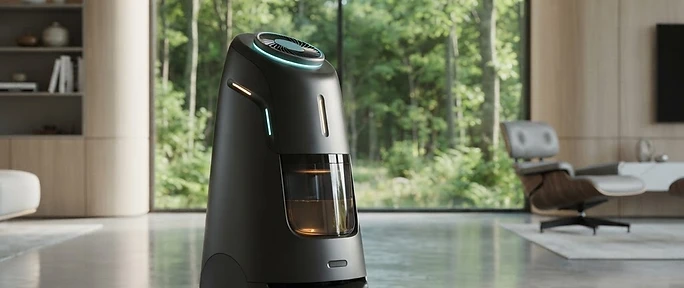
Wendrules are small utility robots designed primarily to save people time and physical effort. Their fundamental market is domestic rather than industrial.
A Wendrule cleans floors, keeps rooms orderly, removes trash, dusts surfaces, cleans sanitary facilities, retrieves objects and continuously removes airborne dust through internal filtration systems. A person can essentially tell one: “Clean the apartment while I'm at work.” The Wendrule determines the sequence of routine tasks itself.
Intelligence
Wendrules possess limited general-purpose AI. They aren't remotely comparable to Jaykes or Jaynes, but they possess enough language capability to hold an ordinary functional conversation.
“I've finished the bedrooms. The stain near the kitchen entrance requires a solvent I don't have. Would you like me to order it?”
That's considerably more sophisticated than today's household appliances without implying consciousness.
Physical Specifications
- HEIGHT
- 70–100 cm
- MOBILITY
- Wheels / tracks depending upon model
- ARMS
- Two multifunction manipulators
- SUGGESTED MAXIMUM INDOOR SPEED
- 8 km/h (5 mph)
- TYPICAL OPERATING SPEED
- 2–4 km/h
- SUGGESTED STANDARD LOAD
- 35 kg
- HEAVY DOMESTIC MODELS
- ≈ 60 kg
Again, maximum velocity remains below human running speed as an intentional safety feature.
Cleaning-Fluid System
Wendrules contain replaceable reservoirs for cleaning concentrates. Users can select scents such as:
- Unscented
- citrus
- pine
- lavender
- ocean
- mint
- vanilla
- floral
- cedar
- manufacturer-specific fragrances
The machine doesn't simply spray fragrance throughout the house. It adjusts cleaning agents according to surface material and contamination. Users can separately control cleaning chemistry and scent, allowing someone to use the appropriate disinfectant while choosing no fragrance at all. Air passing through the Wendrule's internal filtration system removes dust, hair, fibers and suspended particulates.
Extreme-Environment Capability
One of the Wendrule's most useful characteristics is that the basic architecture can be hardened for environments dangerous to humans. Specialized Wendrules can operate in:
- contaminated rooms
- infectious environments
- radiation zones
- vacuum
- extreme heat
- extreme cold
- high-pressure environments
- underwater environments
These are specialized versions of a domestic robot rather than its primary purpose.
EVA Wendrules
Vacuum-rated units can travel outside spacecraft to perform minor external repairs, inspection and cleaning. They aren't replacements for specialized engineering robots. Their advantage is versatility: if a simple component needs replacement outside the hull, a properly equipped Wendrule can sometimes perform the job without exposing a human to vacuum.
Submersible Wendrules
Pressure-rated models can operate deep underwater to inspect equipment, retrieve objects, clean submerged structures or assist in searches. Again, this is secondary capability rather than the reason Wendrules exist.
Diagnostic and Self-Repair Mode
A Wendrule can be ordered into Diagnostic Mode. It performs:
- mechanical diagnostics
- electrical diagnostics
- sensor testing
- actuator testing
- software-integrity testing
- component-life assessment
If replacement components are available, the robot can perform many repairs itself. A household might therefore keep a standard Wendrule repair kit containing wheels, filters, manipulator joints, sensors and other common replacement components. The machine cannot repair catastrophic damage to itself. It also cannot fabricate missing components unless another available system can produce them.
Wendrule Maintenance
Suggested schedule:
- SELF-CLEANING
- daily / as necessary
- WASTE-SYSTEM CLEANING
- after disposal cycles
- AIR FILTER INSPECTION
- every 100 operating hours
- FULL DIAGNOSTIC
- every 250 hours
- HUMAN INSPECTION
- every 500 hours
- MAJOR MAINTENANCE
- every 2,500 hours
- EXTREME-ENVIRONMENT CERTIFICATION
- before and after significant hazardous deployment
Vacuum, radiation, biological contamination and deep-ocean operations trigger additional diagnostics.
Anti-Hacking Protection
Wendrules use the same basic Behavioral Integrity Firewall philosophy as Nadels. This is particularly important because a Wendrule has stronger manipulators. Network commands cannot override:
- maximum manipulator force
- human collision avoidance
- prohibited hazardous actions
- environmental safety controls
- protected diagnostic functions
The household network controls what the Wendrule should accomplish. Its protected internal controller determines what actions are permissible while accomplishing it. This makes compromising someone's home network insufficient to turn their Wendrule into a weapon.
Nadels, Wendrules, Jaykes/Jaynes & Senticoms
The technological progression now becomes much more interesting.
“What work needs doing?”
“What does this customer probably want?”
“How should I understand and respond to this person and situation?”
“What do I want to do?”
That last distinction is enormous.
Wendrules and Nadels are property. Jaykes and Jaynes, despite their extremely sophisticated artificial intelligence and humanlike capabilities, are also not recognized as conscious entities.
A Senticom is conscious. It possesses genuine free will and is legally recognized accordingly. Existing lore establishes that Senticoms organized through AWARE beginning in 2104 and finally received Consortium recognition as conscious entities in 2154.
That means putting a Senticom in charge of a restaurant isn't equivalent to installing better restaurant software. You've employed — or entered into an arrangement with — a conscious being.
This also gives the Zul'Elkoen universe a useful technological boundary: intelligence and consciousness are explicitly not the same thing. A machine can be extraordinarily intelligent, conversational, adaptive and humanlike without Consortium science or law concluding that it is conscious.

