
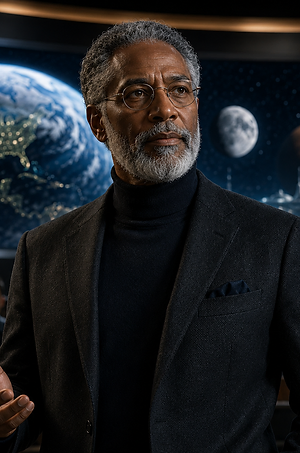
The Fillmore Lectures
University of Nokomis · Luna Province · 2087
Four lectures on why civilizations survive, delivered by Professor Halson Juan Fillmore, and later recognized as the philosophical foundation of the Lurran Consortium.
“Civilizations rarely collapse because they become weak. They collapse because they stop adapting.”
Title
The Fillmore Lectures
Delivered
April 2087
Venue
University of Nokomis
Location
Luna Province, Luna
Lecturer
Halson Juan Fillmore
Discipline
Comparative Civilizations
Lectures
Four
Status
Foundational Text
Overview
The Fillmore Lectures are a series of four public lectures delivered by professor Halson Juan Fillmore at the University of Nokomis in Luna Province during April 2087. They are regarded as the foundational statement of Fillmore's political philosophy and, later, as the intellectual seed of the Fillmore Doctrine ratified in 2095.
The lectures drew on nearly thirty years of comparative historical study. Fillmore examined empires, kingdoms, republics, democracies, dictatorships, and confederations, searching for recurring patterns rather than isolated events. His guiding question was deceptively simple: why do civilizations survive?
At the time of delivery the lectures were received with admiration, skepticism, and considerable controversy. Editorials across Earth described them as impractical, idealistic, unrealistic, and dangerously ambitious, and few contemporaries expected them to influence history. Only decades later, after permanent settlements beyond Earth, expansion throughout the Solar System, and the first preparations for interstellar voyages, did scholars return to the lectures with renewed interest.
They discovered that Fillmore had not attempted to predict the future. He had attempted to understand the past. His conclusion surprised nearly everyone.
“Civilizations rarely collapse because they become weak. They collapse because they stop adapting.”
Halson J. Fillmore, 2087
Lecture I
Fear of the Other
17 April 2087
Lecture II
The Cost of Isolation
April 2087
Lecture III
The End of Scarcity
April 2087
Lecture IV
Beyond Democracy
April 2087
Lecture I · 17 April 2087
Fear of the Other
Xenophobia and the Decline of Civilizations
Fillmore opened the series by examining a recurring force that he believed had quietly shaped human history: not economics, not religion, not military power, but fear of people who seem different from ourselves.
Spain and the Price of Exclusion

Fillmore began with Spain, not because it was unique but because it demonstrated something history would repeat. At the close of the fifteenth century Spain stood among the most powerful kingdoms on Earth: its explorers crossed oceans, its armies expanded influence across continents, and its treasury overflowed with wealth from the Americas. Beneath that success another story was unfolding. In 1492 Spain expelled large portions of its Jewish population; more than a century later, Moriscos — Muslims who had converted to Christianity — were expelled as well.
The motivations were complex: religion, politics, security, and national identity. Fillmore cautioned against reducing history to a single cause, and instead asked what happened after these people were gone. Many had been merchants, physicians, engineers, farmers, craftsmen, scholars, and bankers. Communities that had contributed to Spanish society for generations disappeared almost overnight. The expulsions did not alone cause Spain's gradual decline, but they accelerated existing weaknesses: they reduced economic resilience, narrowed intellectual diversity, and removed thousands of experienced people precisely as Europe entered one of its most transformative periods.
Fear seldom destroys a civilization in a single generation. More often, it quietly limits the number of minds available to solve tomorrow's problems.
Halson J. Fillmore
Nazi Germany and the Brain Drain

If Spain demonstrated the long-term costs of exclusion, Nazi Germany illustrated how rapidly those costs could appear. Few nations entered the twentieth century with Germany's scientific reputation; its universities attracted some of the finest physicists, chemists, physicians, mathematicians, and engineers in the world. Then ideology intervened. As racial persecution intensified, thousands of scientists, academics, physicians, and entrepreneurs fled the country, and many found refuge elsewhere, later contributing to advances that reshaped the modern world.
Fillmore did not present the episode merely as a moral failure, though he acknowledged it as one. He drew a second lesson: a civilization cannot afford to drive away those capable of helping it adapt. Knowledge does not disappear. It simply changes addresses. While he resisted simplistic conclusions — Germany did not lose the Second World War because talented people emigrated — he argued that ideological exclusion deprived the state of intellectual resources at precisely the moment when innovation had become one of the defining elements of modern conflict.
History has a peculiar habit. When one civilization rejects talent because of identity, another civilization usually welcomes it because of ability.
Halson J. Fillmore
Ming China and the Cost of Looking Inward
The third case came from Asia. For centuries China possessed one of the world's most advanced civilizations, its engineers, navigators, artisans, and scholars influencing much of Eurasia. During the Ming Dynasty, however, policies increasingly restricted maritime activity and foreign engagement. Historians continue to debate the motivations — security concerns, internal politics, economic priorities — and Fillmore acknowledged all of them before asking his students to consider something larger.
When a civilization voluntarily reduces its exposure to new ideas, innovation slows over generations, adaptation becomes more difficult, and competing civilizations continue experimenting while one increasingly looks inward. Fillmore stressed that isolation is not always irrational; every civilization has legitimate security concerns, and every nation has the right to protect itself. The question was never whether boundaries should exist, but whether fear had become the primary architect of those boundaries.
History rarely rewards civilizations that close every door. It is equally unforgiving toward those that remove every wall. Wisdom lies not in choosing one extreme, but in knowing which doors should open, when, and why.
Halson J. Fillmore
Closing Remarks
Three civilizations, three centuries, three cultures, and three political systems revealed a common lesson: fear can become a useful warning, but when fear becomes a governing philosophy, civilizations often lose something more valuable than territory or wealth. They lose the ability to learn.
Fillmore ended his first lecture with a caution that surprised much of his audience. He did not argue that every society should open its borders or abandon its identity. He insisted that history also contains warnings against naïve openness, and that the challenge was not choosing between identity and diversity but discovering how both could strengthen one another. That question became the subject of his second lecture.
A civilization does not become stronger because it welcomes everyone. Nor does it become stronger because it welcomes no one. Strength comes from learning how to recognize partners without forgetting who you are.
Halson J. Fillmore
Duration ≈ 12 minutes
Lecture II · April 2087
The Cost of Isolation
Identity, Fear, and the Search for Balance
The second lecture answered the misreading of the first. Fillmore was not advocating unbounded openness, nor the dissolution of national identity; he rejected both extremes and asked instead how a civilization preserves itself without isolating itself.
Tokugawa Japan

For more than two centuries Japan pursued a policy historians often describe as national isolation. Foreign influence was heavily restricted, international trade tightly controlled, missionaries expelled, and outside political influence limited. Most historians emphasize the costs of these policies; Fillmore began elsewhere, asking what Japan gained: political stability, internal peace, and cultural continuity. For generations Japan avoided many of the wars that devastated other regions, and its language, customs, and institutions remained remarkably cohesive. Fillmore admired the achievement and believed historians often overlooked it.
History nonetheless presented another lesson. While Japan remained relatively stable, the outside world continued changing: industrial technology advanced, naval power transformed, scientific knowledge expanded. When foreign fleets finally arrived in the nineteenth century, Japan confronted a world very different from the one it had left behind. Remarkably, it adapted, and rapidly. The Meiji Restoration demonstrated, in Fillmore's reading, that isolation had preserved the civilization while adaptation preserved its future.
A civilization cannot remain unchanged while the world around it changes. Stability is valuable. Permanence is an illusion.
Halson J. Fillmore
The Ottoman Empire
If Japan illustrated the strengths and limitations of isolation, the Ottoman Empire demonstrated both the opportunities and the challenges of diversity. For centuries the empire governed an extraordinary collection of peoples — different languages, religions, cultures, and traditions. Despite these differences commerce flourished, ideas crossed borders, knowledge spread, and cities became centers of learning and trade.
Fillmore argued that historians often describe the empire either as an example of successful diversity or as inevitable fragmentation, and that both interpretations are incomplete. Diversity was neither the empire's weakness nor automatically its strength. The true question was whether institutions could maintain cooperation among increasingly distinct populations. Over time economic pressures intensified, national identities strengthened, political trust weakened, and shared institutions struggled to keep pace. The empire gradually fractured. Fillmore paused in the lecture hall and asked his audience what had failed. Then he answered his own question: it was not diversity, but cooperation.
Differences do not destroy civilizations. The inability to manage those differences eventually does.
Halson J. Fillmore
Rwanda

The final case came from the twentieth century. Fillmore approached the subject with extraordinary care, reminding students that behind every historical statistic exists a human life: parents, children, neighbors, and friends. The genocide of 1994 demonstrated how rapidly fear can overwhelm ordinary human relationships, tearing apart communities that had lived alongside one another for generations. Political propaganda, historical grievances, economic uncertainty, and fear each reinforced the others.
Fillmore refused to simplify these events, and refused to exploit them for rhetorical effect. Instead he returned to a recurring theme: fear rarely appears suddenly. It accumulates, it spreads, it becomes normalized, and eventually people begin seeing categories instead of neighbors.
The greatest danger is not when a civilization fears outsiders. It is when neighbors begin believing that one another have become outsiders.
Halson J. Fillmore
Closing Remarks
Fillmore concluded that history had revealed two recurring mistakes: isolation born from fear, and the assumption that diversity alone guarantees success. History supported neither conclusion. Civilizations survive because they learn, because they integrate, because they adapt, and because they preserve the traditions worth preserving while remaining willing to discover new ones.
He then offered one of the most discussed observations of the series. At the time it seemed almost speculative; many historians now regard it as the moment his philosophy began looking beyond Earth. Humanity had spent nearly all of its history competing for limited land on a single world, but technology and civilization were changing, and perhaps the conditions that had shaped politics for thousands of years were beginning to disappear.
For thousands of years humanity argued over who belonged within the walls. Few paused to ask whether the walls themselves would someday become unnecessary.
Halson J. Fillmore
Duration ≈ 12 minutes
Lecture III · April 2087
The End of Scarcity
Technology, Cooperation, and Humanity's Expanding Frontier
Critics accused Fillmore of abandoning history for speculation. He insisted he was doing precisely the opposite, arguing that every civilization in history had been shaped by the same unavoidable reality: scarcity.
The Age of Relative Abundance
For thousands of years governments were forced to answer one difficult question: who gets access to limited resources? In Fillmore's view nearly every political system ever devised was, at least in part, an attempt to manage scarcity of food, land, energy, water, minerals, employment, and housing. He then asked what would happen when scarcity itself began to change.
Fillmore cautioned his audience against believing that technology solves every problem; history had already disproven that idea many times. Technology, he argued, changes the kinds of problems civilizations must solve. Advanced agriculture produces more food from less land than any previous civilization imagined possible; factories manufacture goods with fewer workers and higher quality; artificial intelligence assists physicians, engineers, teachers, and researchers; fusion energy, advanced recycling, autonomous mining, and precision manufacturing continue reducing the cost of necessities. None of these developments eliminate scarcity. They redefine it.
He reminded his students that fear often grows from uncertainty. When people believe there will never be enough, cooperation becomes more difficult, competition intensifies, suspicion grows, and political movements built on fear become easier to sustain. History, he argued, demonstrates this pattern repeatedly.
The question is no longer whether humanity can produce enough. Increasingly, the question is whether humanity can organize itself wisely enough to distribute what it is capable of producing.
Halson J. Fillmore
Humanity Outgrows a Single World

For nearly all of recorded history humanity shared one home. Every civilization, every empire, every nation, every border, every war, and every migration occurred upon a single planet. Fillmore believed that reality was ending — not because Earth had become unimportant, but because humanity itself was becoming larger than Earth. He spoke of permanent settlements beyond Terra: cities beneath the oceans, research stations upon the moons of the outer planets, industrial facilities in the asteroid belt, and eventually settlements orbiting distant stars.
As humanity dispersed, he argued, population density on any single world would gradually decline. Pressure on land, housing, resources, and political institutions would not disappear completely, but each would increasingly be shaped by a simple truth: human civilization would no longer be confined to one planet.
The Earth was never too small. Humanity's imagination was.
Halson J. Fillmore
Every generation believed it was running out of room. Every generation underestimated the universe.
Halson J. Fillmore
Cooperation Beyond Borders
Fillmore was not calling for humanity to abandon nations, languages, traditions, or cultures. He believed local identity remained one of civilization's greatest strengths. Instead he proposed that humanity had reached a point where cooperation could become more important than competition in many areas: scientific research, disaster response, planetary defense, space exploration, medicine, environmental restoration, and resource development. These challenges increasingly crossed political boundaries.
History, he argued, had trained humanity to think locally because humanity had lived locally. Technology was changing that assumption.
The measure of civilization is no longer how effectively we compete for yesterday's resources. It is how wisely we cooperate to create tomorrow's opportunities.
Halson J. Fillmore
The Mirror of First Contact
Near the end of the lecture Fillmore shifted from history to philosophy. He acknowledged the work of fellow historian Serge Frantelli, who had argued that humanity should establish a coherent doctrine for extraterrestrial diplomacy before first contact ever occurred. Fillmore found the argument persuasive — not because he believed contact was imminent, but because preparing for it forced humanity to ask difficult questions about itself. How should strangers be treated? How should differences be understood? How should trust be earned?
He reminded the hall that a civilization's conduct toward the unfamiliar beyond its borders would be an extension of its conduct within them.
Our first contact with another civilization will reveal less about them than it will about ourselves.
Halson J. Fillmore
If fear defines our relationships with one another, why should we expect wisdom to define our relationships with anyone else?
Halson J. Fillmore
Closing Remarks
Fillmore left his audience with an idea many considered impossible: humanity was approaching a moment when it could remain culturally diverse, politically independent, and geographically dispersed while cooperating more closely than ever before — not because human nature had changed, but because civilization had.
He ended with a sentence that puzzled many in 2087 and would become one of the defining declarations of his career. He did not explain what he meant. Not yet. That explanation became the subject of his fourth and final lecture.
It is not an alliance that I propose. Not a federation. Not an empire. Not a dominion. But rather… a consortium. One that comes together for a single purpose — the survival of human civilization.
Halson J. Fillmore
Duration ≈ 12 minutes
Lecture IV · April 2087
Beyond Democracy
Civilization Beyond the Nation-State
By the spring of 2087 many journalists had concluded that Fillmore opposed democracy, or wished to replace governments altogether. He opened his final lecture by correcting the record.
The Record Corrected
Fillmore stood silently for several moments before addressing the audience. He affirmed that representative democracy stands among humanity's greatest political achievements: it expanded liberty, restrained power, made peaceful transfers of authority possible, and gave ordinary citizens a voice where previously there had often been none. Then he observed that it also has limitations.
He was not asking whether democracy had succeeded; history had already answered that question. He was asking whether institutions designed for industrial nations on a single inhabited planet would remain sufficient for a civilization spread across many worlds.
Representative democracy stands among humanity's greatest political achievements.
Halson J. Fillmore
Every Political System Solves the Problems of Its Time
Fillmore argued that political systems evolve because civilizations evolve. City-states solved problems that kingdoms could not; kingdoms solved problems that tribal alliances could not; representative democracy solved problems that monarchies often struggled to solve. None of these systems appeared because philosophers imagined them. They emerged because history demanded them.
He cautioned his students against believing any political system represented the final chapter of human civilization, and pointed to a recurring pattern: every successful political system eventually encounters circumstances its founders never anticipated — steam engines, electricity, nuclear energy, artificial intelligence, spaceflight. Each transformed civilization. Politics adapted, usually more slowly than technology itself.
Every generation mistakes its institutions for permanent truths. History suggests otherwise.
Halson J. Fillmore
Democracy's Structural Limitations

Fillmore's critique of democracy was neither moral nor ideological. It was structural. Representative democracy, he argued, naturally emphasizes the concerns of the present generation: election cycles encourage immediate results, and long-term projects extending across decades can become difficult to sustain when leadership changes frequently. He observed increasing political polarization throughout many democratic societies — not because democracy creates disagreement, since disagreement is healthy, but because modern communication technologies increasingly rewarded outrage over deliberation.
He also questioned whether highly technical decisions involving artificial intelligence, planetary engineering, deep-space navigation, or interstellar infrastructure could always be resolved through ordinary electoral politics alone. His point was not that experts should rule, nor that citizens should surrender their voice, but that increasingly complex civilizations require increasingly sophisticated institutions.
The audience shifted uneasily; some applauded and others folded their arms. Within days commentators across Earth accused Fillmore of proposing technocracy. He denied the accusation repeatedly. His lecture had never suggested replacing democratic legitimacy — it suggested complementing it with institutions capable of thinking beyond election cycles.
Democracy asks an essential question: 'What do the people wish to do?' Civilization must also ask another: 'What will best serve the generations not yet born?'
Halson J. Fillmore
The vote remains indispensable. It is not, however, the only instrument by which a civilization measures wisdom.
Halson J. Fillmore
What the Consortium Is Not
Perhaps the greatest misunderstanding surrounding Fillmore's work emerged from a single word: consortium. Many immediately imagined another government, another bureaucracy, another empire. Fillmore rejected each interpretation. He emphasized that cooperation need not require political uniformity: independent societies could remain independent, different cultures could remain different, and local governments could continue making local decisions.
Shared problems, however, increasingly demanded shared solutions — planetary defense, scientific research, interstellar exploration, disease surveillance, resource coordination, and disaster response. These challenges ignored national borders and would, in time, ignore planetary borders as well. Civilization itself had become the project requiring coordination, not because humanity had become identical, but because humanity had become interconnected.
A government governs. An empire commands. A consortium coordinates.
Halson J. Fillmore
Unity is not sameness. Cooperation is not surrender. Identity need not disappear for civilization to advance.
Halson J. Fillmore
Closing Remarks
Fillmore closed the series by returning to the question that had begun it: why do civilizations survive? His answer had evolved across four lectures. Civilizations survive because they adapt, because they learn, because they refuse to let fear become their defining principle, and because they preserve what deserves preserving while remaining courageous enough to build what has never existed before.
He gathered his papers. The audience rose in polite applause. Some admired him; others remained unconvinced. Editorials published the following morning described the lectures as impractical, idealistic, unrealistic, and dangerously ambitious, and few believed his ideas would influence history. Yet over the decades that followed, as humanity expanded beyond Earth and confronted challenges no previous civilization had ever faced, scholars returned to these lectures with renewed attention — not because Fillmore had predicted the future perfectly, but because he had recognized something profound. The greatest frontier awaiting humanity was never merely the distance between the stars. It was the distance between fear and cooperation.
Civilizations are not measured by the height of their towers, the strength of their armies, or the wealth of their markets. They are measured by the number of strangers who become neighbors… the number of rivals who become partners… and the number of generations they leave better prepared than they themselves were.
Halson J. Fillmore
Duration ≈ 12 minutes
Legacy
For the remainder of the twenty-first century the Fillmore Lectures circulated as recordings, transcripts, and classroom assignments rather than as policy. Their influence became visible only after humanity's expansion beyond Earth made the lecturer's central problem concrete: how to coordinate a civilization that no longer shares one world without extinguishing the identities that make it worth preserving.
In 2095 the founding doctrine of the Lurran Consortium was ratified. Its architects drew heavily on Fillmore's distinction between governing, commanding, and coordinating, and on his insistence that unity is not sameness. The doctrine bears his name.
“History does not ask whether we were right. It asks whether we survived.”
The Fillmore Lectures, 2087
Reader Discussion
0 comments
No comments yet. Be the first to discuss this story.

