
23 FEBRUARY 2365 \u00B7 AET 04637G
Phase I Before We Name the Unknown
Expedition assembly, the CSV Gulliver, and the Terra baseline.
The expedition began with a one-sentence proposal: apply the Velkth-derived Orphetuological system to ordinary life across nearby systems, not merely to Tauni civilizations, medical curiosities, or Leviathans. The project would begin on Terra as a calibration world, then examine five locations in each of seventeen stellar systems.
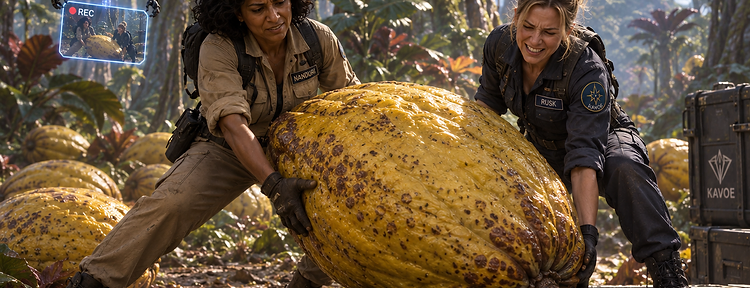
Before the Gulliver left Sol, the crew spent weeks on Earth verifying every instrument against known organisms. The baseline was not glamorous. It was essential. If the procedures failed here, among organisms wrapped in centuries of observation, there would be no excuse later on Amber and Red worlds where security, weather, geology, and wildlife would all become less forgiving.
The Expedition Director
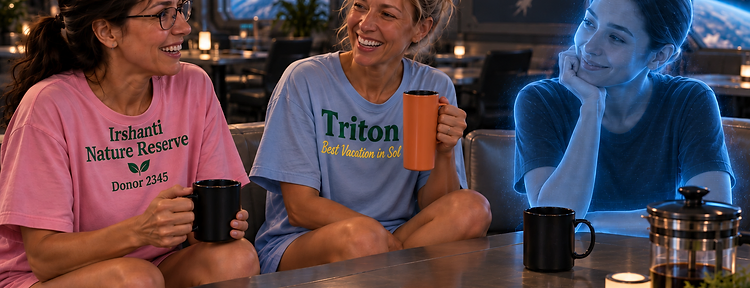
At forty-two Earth years of age, Dr. Marissa Edgington had spent enough of her life around scientists to distrust anyone who said, "We know what this is," before collecting a sample. She was a Bioxenologist more commonly, in the newer Velkth-derived terminology, an Orphetuologist with advanced concentration in Kaveth classification, Elnovar ecology, and comparative field biology.
Her interest in field biology began with Jacques Cousteau. As a child she watched restored recordings of his ocean expeditions until her family could quote the narration with her. Charles Darwin became a second hero during adolescence. She admired his willingness to let observations alter an argument, although she later disagreed with several of his final assessments concerning the Precambrian period.
She completed ORG 3, was recruited by SIAGE into a junior comparative-biology program, worked for Ventopia as a field xenoecology consultant, served three years in KAVOE, and spent years conducting independent surveys before proposing the Sectors 1\u20137 expedition. KAVOE taught her pressure discipline, emergency procedure, and the value of following a checklist when everyone in the room believed they were too clever to need one.
"A HEILO could place an encyclopedia in a person's head. It could not make the person notice the animal hiding beneath the encyclopedia."

Patrick and Giorodva
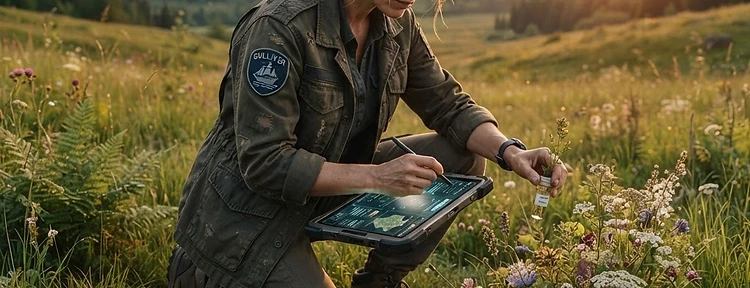
Patrick was the expedition's Jayke. He was not counted among the eleven human personnel, but by the end of the first week no one considered him optional. He handled repetitive sampling, lifted equipment, assisted Andrew, maintained inventory, performed night work, and could stand beside a bored scientist for six hours without becoming bored himself. His greatest contribution was less measurable: Patrick was funny. Sometimes intentionally. Sometimes not. He required no sleep, which made him useful at three AM and deeply irritating at breakfast.
Giorodva was the Senticom who voluntarily integrated with the Gulliver's operating network. Giorodva preferred an androgynous avatar and a soft, pleasant speaking voice. Unlike Patrick, Giorodva was recognized as a conscious person. The expedition contract described the Senticom as a cooperating mission specialist rather than equipment. Giorodva could monitor navigation, atmosphere, life support, communications, laboratory alarms, exterior sensors and internal safety systems continuously, provided the vessel's power and Thrishton-dependent systems remained functional.
"Pleasant enough to make you forget someone is awake while everyone else sleeps."

The CSV Gulliver
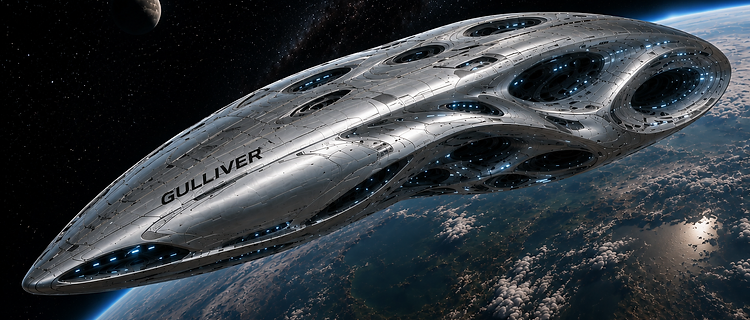
The Gulliver was a privately chartered civilian survey vessel built for long-duration scientific work rather than freight or luxury travel. From outside, she resembled a flattened silver-gray spindle with a blunt sensor-heavy bow, two swept equipment shoulders, a narrow axial hull, and paired maneuvering structures aft. Her hull carried no military markings.
Interstellar transit used a Gorbillian manipulation drive. Local movement used Promegen Generation 4.3+ controlled-fusion thrusters with QV thrusters for fine maneuvering and station keeping. Electrical power came from a D-T controlled-fusion plant with a separated controlled-fission emergency system. The distinction mattered: the Gorbillian system manipulated metric conditions for interstellar travel; it was not expected to replace every conventional engine aboard the ship.
She had eleven sleeping cabins, two guest/medical-isolation cabins, a galley, bridge, engineering compartment, medical suite, wet and dry laboratories, sample vault, and two main airlocks.
Quincy called her "a fish that had evolved laboratory instruments instead of whiskers."
Survey systems included ground-penetrating radar; long-range multispectral scanning; atmospheric, aerosol and liquid samplers; sterile tissue and body-fluid collectors; traps for microscopic and macroscopic organisms; automated dung and urine collection kits; external vacuum sample arms; subsurface probes; portable environmental stations; radiation monitors; gravimetric instruments; Thrishton-density sensors; and space-time disturbance monitors. ACS provided routine long-range network communications where infrastructure permitted, while quantum communications equipment was carried for designated scientific and emergency links.


Why Begin on Earth?
"I have been asked why an interstellar biological survey begins on Earth. Because if your system cannot describe the organisms you already understand, it has no business describing the ones you do not."
Terra has accumulated too many names for one world. Earth in ordinary English. Terra in most formal interstellar records. Sol III when pretending to be astronomers. Lurran in older political and cultural usage. For the survey, Marissa used Terra in formal entries and Earth when she forgot she was being formal.
The Orphetuological System
Orphetuology does not replace evolutionary biology. It answers a different question. Traditional Terran classification asks what organisms are related to. The Velkth-derived system begins by asking what an organism does. Veyra describes life architecture. Brerokan describes the primary feeding strategy. Nethra, Orrakai, Kel, Vosha, Taren and Orphel progressively narrow ecological form, functional class, behavior, morphology, organism kind and the defined organism.
The advantage is obvious once one leaves Earth: a six-legged alien with feathers, milk glands and external eggs is not a "bird-mammal." It is whatever it actually does.


Terra Baseline Organisms
| Organism | Placement | Note |
|---|---|---|
| Oak (baseline reference) | Brerokanquois > Quoisol | Calibration organism. Used to verify field equipment before departure. |
| Earthworm (baseline) | Brerokanzwoph > Zwophdec | Decomposer calibration sample. Soil ecosystem reference. |
| Honeybee (baseline) | Brerokanzwoph > Zwophfil | Pollinator calibration. Behavioral baseline for filter-feeding analogues. |
| Cousteau Kelp (baseline) | Brerokanquois > Quoisol | Marine producer reference. Named for Marissa's childhood inspiration. |
| Darwin's Finch (baseline) | Brerothokni > Thokgra | Behavioral calibration. Named for Marissa's second hero. |

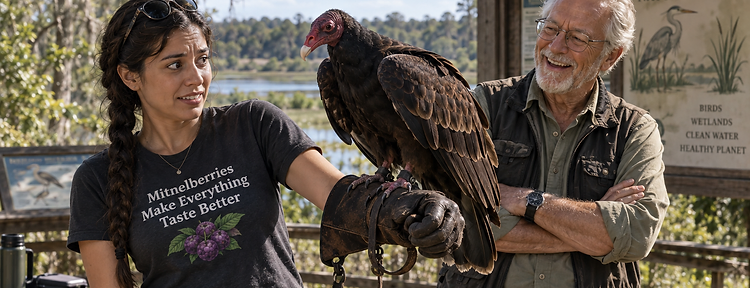
Field Notes from Calibration
First Correction. The earthworm was originally placed in a simple Brerothokni category because it ingests biological material. Bethany objected before lunch. She was right. The classification is supposed to distinguish harvesting living producer tissue from processing detrital material. The first note was retained in the archive because deleting mistakes teaches nothing. Revised placement: Brerokanzwoph, detrital subtype, with species-level exceptions to be recorded where appropriate.
The Slime Mold Argument. The slime mold caused a longer argument. Sabrina wanted cellular chemistry given more weight. Gweneth argued that a life cycle capable of changing organization should be allowed a phase-dependent functional record. The instinct was to demand one clean answer because this was the baseline. That was precisely the wrong instinct. A classification system designed for alien life cannot become less flexible merely because the first troublesome organism lives on Earth.

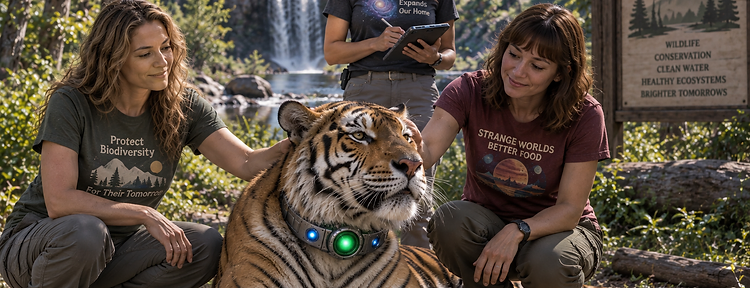
Crew Moments
Rick asked when they expected the danger to begin. Marissa told him they were still cataloguing sponges. He stared at her for several seconds and said he had made excellent career choices.
Eduardo did not laugh. He inspected the sentry twice, checked the security seals on the sample vault, asked Jules whether anyone outside the expedition had access to their route, and then asked the same question in a different way. Rick says Eduardo would be suspicious of an empty room because somebody might have emptied it on purpose.
Patrick learned that Quincy becomes irritated when anyone says the first season of Survivor was "just people on a beach." Patrick now says this approximately once every six hours. Giorodva declined to intervene on the grounds that no safety regulation prohibits annoying a geologist.

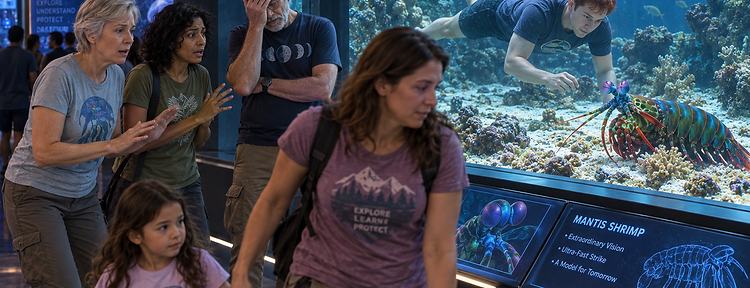
The Sol-System Calibration Plan
The final Sol-system calibration used five locations: Terra as the terrestrial baseline; Jupiter as the gas-giant atmospheric baseline; Ganymede and Titan as the two moon surveys; and Ceres as the miscellaneous-body survey. Terra's twelve teaching organisms were not the formal five-entry limit \u2014 the expedition knew too much here to pretend five examples were sufficient. The formal registry would select five representative Terran entries while retaining the expanded teaching set in the journal.
Tomorrow they would leave the Earth baseline behind. The first nearby systems were not remote by modern standards, but that was the point. Orphetuology should not require an expedition to the far side of the galaxy to prove its usefulness. If two biospheres separated by a few light-years could produce organisms that look unrelated yet perform the same ecological work, the Velkth were right to classify function first. If they could not, then an elegant vocabulary had been built for a bad idea.
"I prefer the first possibility. I am prepared for the second."
Departure
The Gulliver cleared final inspection with all primary survey systems operational. The expedition departed the Terra staging orbit with eleven human personnel, Patrick, Giorodva, one sentry, ten Wendrules, and the full scientific manifest aboard. No biological discovery had yet been made beyond the baseline. That was intentional. Before naming the unknown, Edgington's team had established how it would admit error when the unknown refused to behave.
Reader Discussion
0 comments
No comments yet. Be the first to discuss this story.

