
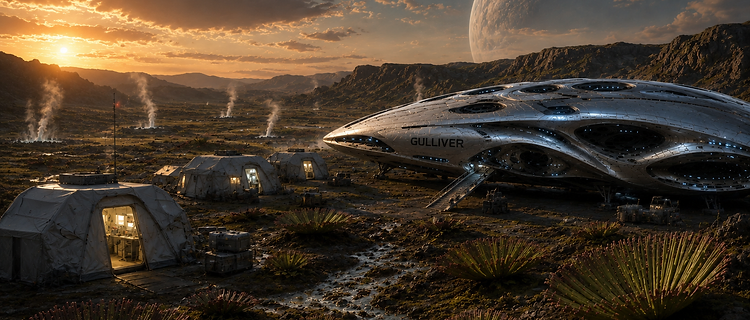
JULY\u2013OCTOBER 2365
Phase IV The Expedition Eats Its Specimens
Grubox failure, the hunt, a predator charge, and a Leviathan defending its young.
Teegarden's Star / Asteria
Journal \u2014 24 July 2365
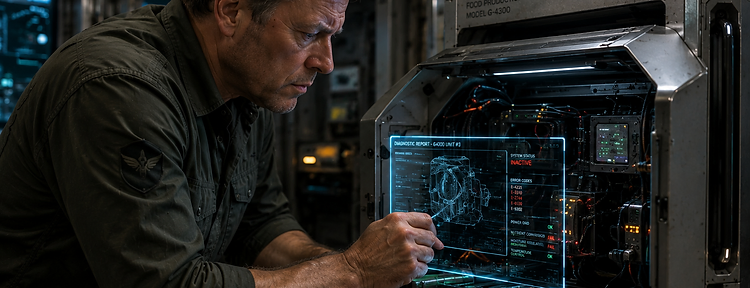
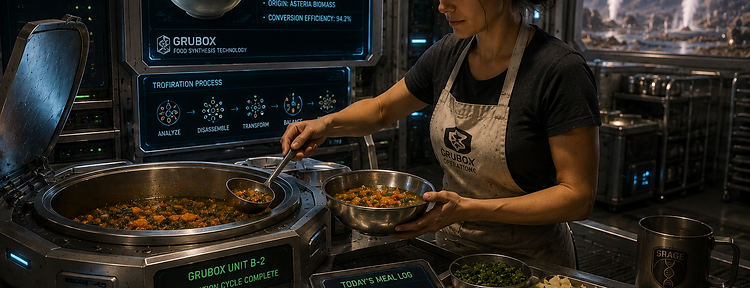
Bethany told Marissa that she had tempted fate. Marissa told her that fate was not a variable recognized by Orphetuology. Three days later the best Grubox failed. The failure was not dramatic. No sparks. No alarm. The unit simply stopped completing trofiration cycles. Andrew opened the service housing, stared at the diagnostic field for almost a minute, and used language omitted from the official record. The remaining two Gruboxes could still feed them, but their redundancy had just become their entire food system.
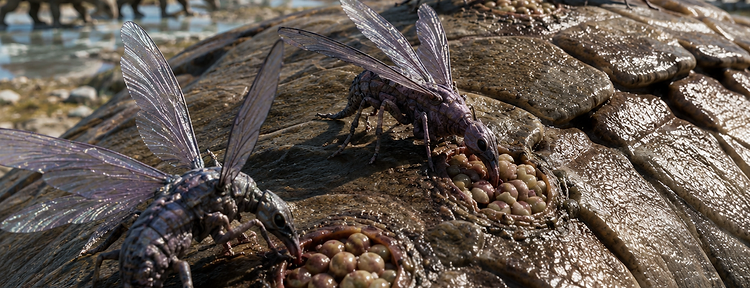
Asteria itself was worth the anxiety. Its terrestrial survey site was a broad upland basin where low producers grew in radial fans around warm mineral seeps. The largest herbivore analogue, which they called a Plateback, moved in groups of twenty to forty and shaved the fans down with paired mouth plates. Small six-winged organisms followed the herds and fed on exposed reproductive nodules. A low, muscular hunter shadowed both species from the rocks.
Patrick: 'The good news is that two Gruboxes remain functional.'
Andrew: 'Do not tell engineers the good news while they're looking at the bad news.'
Asteria Selected Organisms
| Location | Organism | Placement | Field Note |
|---|---|---|---|
| Asteria | Plateback | Brerothokni › Thokgra | Social grazer with overlapping dorsal plates and paired scraping mouth structures. |
| Asteria | Radial Fan | Brerokanquois › Quoisol | Low producer concentrated around mineral seeps. |
| Asteria | Sixwing Nibbler | Brerothokni › Thokbro | Small flyer that selectively consumes reproductive nodules. |
| Asteria | Ridge Stalker | Brerokantha › Kanthask | Rock-colored ambush predator of Plateback juveniles. |
| Asteria | Silver Thread | Brerokanzwoph › Zwophpar | External parasite living beneath Plateback armor margins. |
Twenty-Seven Missing Packs
The Maganda Foods inventory discrepancy appeared two days later. Twenty-seven nutrient packs were gone. These packs were not meals. They were concentrated elemental and molecular feedstocks used to keep the Gruboxes supplied with the material from which meals could be trofirated. Someone had taken a large fraction of the reserve while cargo was being transferred between secured storage and the Gulliver.
GIORODVA reconstructed the chain of custody but could not identify the thief from the available recordings. The missing packs had passed through a blind interval created when a local cargo system temporarily replaced their own tracking tags. Rick called it theft. Eduardo called it predictable. Andrew called it a mass-balance problem. Marissa called everyone to the common room.
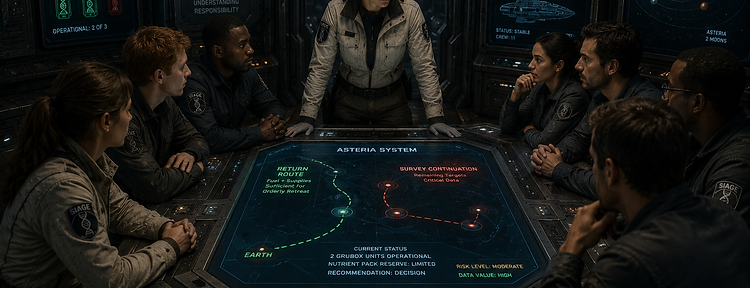
They had enough food for an orderly retreat. They did not have enough feedstock to complete the survey at the planned rate. Ending the expedition was scientifically defensible. Continuing meant obtaining replacement elemental material locally. They continued.
For the first time, they stopped treating alien organisms exclusively as specimens and began evaluating some as food resources. Myriyam established exclusion criteria for toxins, pathogens, unknown storage compounds, and cross-reactive proteins. Gweneth screened microorganisms. Sabrina checked molecular compatibility. Urshila identified producer tissues with useful carbohydrate and mineral profiles. The remaining Gruboxes did not need recognizable ingredients; they needed usable matter. But they still had to collect that matter safely.
The irony was not lost on anyone. They had spent months trying not to disturb ecosystems. Now they were discussing sustainable harvest quotas because the expedition needed dinner.

The Hunt
The first deliberate hunt occurred on Asteria's second moon. They selected a common medium-sized grazer whose population surveys showed no local conservation concern. Marissa insisted that they take one animal and use as much of it as possible. Rick reminded her that he had been ordered not to solve ordinary wildlife problems for them.
Marissa: 'I know.'
Rick: 'Just checking.'
Eduardo: 'He has been waiting months to say that.'
Bethany tracked the herd. Quincy and Jules drove two animals away from a steep ravine. Marissa made the final decision on the individual. Patrick retrieved the carcass after the kill and carried it back to the field shelter with a level of casual efficiency that made several of them uncomfortable.
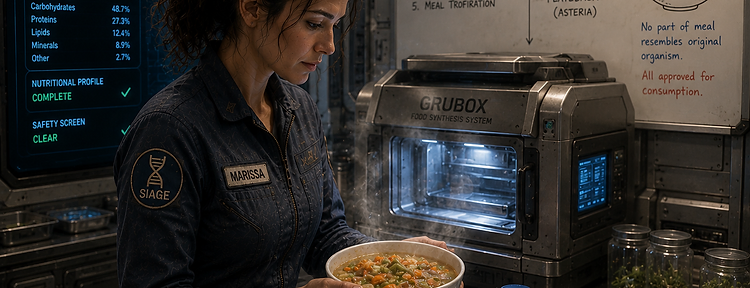
The experience was scientifically useful and emotionally unpleasant. They sampled muscle, organs, mineralized tissues, gut contents, excretory products, and associated parasites before converting approved material into Grubox feedstock. The first meal produced from the recovered matter was an Earth-style vegetable stew. No part of it looked like the animal they had killed. That somehow made it stranger.
"Classification becomes morally easier when the classified thing remains on the other side of a scanner. Cousteau ate on expeditions. Darwin collected animals. Field biology has never been as clean as retrospective documentaries make it appear."

Tau Ceti The Four-Jaw Runner
Tau Ceti brought them into a biologically famous system and gave them their most frightening ground encounter so far. The survey camp had been established on a permitted moon site well away from settled zones. Their security team remained under the same instruction: intelligent attackers were their responsibility; ordinary fauna were the expedition's unless an immediate threat exceeded their ability to respond.
At dusk, a large quadrupedal predator emerged from broken vegetation approximately eighty meters from camp. It was nearly three meters long, low at the shoulder, and covered in dark flexible scales. Bethany saw it first. It did not stalk. It accelerated.
Rick raised his rifle but did not fire. At sixty meters the animal continued directly toward them. At forty, Patrick moved between Sabrina and the approach vector. At thirty, Marissa shouted at Rick. He still waited. At approximately twenty meters the predator lowered its head, opened four lateral jaw plates, and increased speed. Rick fired once.
The animal collapsed before reaching the outer sample markers. Myriyam confirmed death. Rick's explanation afterward was simple: until the final acceleration, he could not exclude territorial bluffing, curiosity, or a charge that would terminate before contact. His contract did not authorize him to shoot wildlife merely because it frightened them.
Rick: 'You hired me to protect you, Doctor. You did not hire me to make the wilderness safe.'
Marissa: 'At twenty meters I was prepared to renegotiate.'
They named the animal the Four-Jaw Runner. Its stomach contained two local grazers and mineral-rich nodules apparently swallowed incidentally with prey. It was classified Brerokantha \u203A Kanthavel. Marissa would have preferred to discover that without watching it run at her.
Tau Ceti Selected Organisms
| Location | Organism | Placement | Field Note |
|---|---|---|---|
| Tau Ceti moon site | Four-Jaw Runner | Brerokantha › Kanthavel | Large pursuit predator; four lateral jaw plates. |
| Tau Ceti moon site | Blue Sail Grazer | Brerothokni › Thokgra | Herd animal using vascular dorsal sails for heat exchange. |
| Tau Ceti moon site | Salt Lantern | Brerokanquois › Quoisol | Coastal producer storing salts in luminous nodules. |
| Tau Ceti moon site | Cup Filter | Brerokanzwoph › Zwophfil | Sessile tidal filterer with retractable feeding membranes. |
| Tau Ceti moon site | Stone Needle | Brerokanzwoph › Zwophpar | Skin-boring parasite common on Blue Sail Grazers. |
The Assimilator
The first assimilator failed in the Gliese 687 system. Andrew had warned them that its fabrication chamber was drifting out of tolerance. Then it stopped accepting calibration entirely. The failed Grubox was inconvenient. The assimilator was more serious because it manufactured replacement components for equipment that could not be repaired from ordinary stock. Andrew needed two field-control assemblies and a set of precision lattice elements. They did not have them. A local contact knew people who did.
The people arrived in a battered surface transport with no company markings, no verifiable business registry, and enough weapons to make Eduardo stop pretending this was a legitimate transaction. They never called themselves pirates. The expedition never called them pirates. Patrick later observed that this was the most polite conversation he had ever recorded between two groups who mutually believed the other group might shoot them. They wanted equipment rather than currency. Their final price was two Vertikron rifles.
Eduardo: 'No.'
Andrew: 'Then the assimilator stays broken.'
Eduardo: 'Still no.'
Marissa: 'What do we retain?'
Rick: 'One thorium rifle. Two Vertikron pistols. Our personal security equipment.'
Eduardo: 'Doctor, please do not turn inventory into permission.'
Marissa authorized the trade. Eduardo did not speak to her for forty-three minutes. Patrick timed it. The parts worked. Andrew repaired the assimilator, which then fabricated the components needed to restore several smaller survey systems and rebuild part of the failed Grubox control assembly. The Grubox itself remained unreliable, but the ship was again capable of manufacturing specialized replacement hardware.
Marissa recorded the transaction as an emergency procurement from an unverified supplier. Eduardo recorded it as "giving pirates two perfectly good rifles." Both descriptions are accurate.


Gliese 687 An Organism That Fooled Us Twice
On the largest moon they encountered a field of pale crystalline growths emerging from cracks in exposed rock. They warmed slightly during daylight and produced simple organic compounds. Marissa classified them Brerokanquois \u203A Quoisol. At night, mobile fragments detached and crawled across the rock toward small burrowing animals.
She revised them to Brerohurnocio. Then Gweneth demonstrated that the mobile fragments returned to the same parent structures before local sunrise and shared stored metabolites across the colony. They had not discovered separate nocturnal predators living among producers. They had discovered one dual-mode organism whose feeding strategy changed with illumination.
FIELD REVISION 4-01 Moonshard
Initial: Brerokanquois \u203A Quoisol
Revised: Brerohurnocio \u203A Hurnoeq
Cause of error: Observation restricted to illuminated phase. This is precisely why a twelve-hour survey can produce a confident wrong answer.
The Dead Pocket
The Gorbillian dead pocket occurred between Gliese 687 and their next scheduled system. There was no warning. Jules initiated the manipulation sequence. The Gulliver's systems reported normal power, normal control response, and no mechanical fault. The expected translation simply did not occur.
Andrew shut the system down, inspected it, restarted it, and obtained the same result. GIORODVA compared the event against every onboard diagnostic model and found no equipment failure. Their space-time disturbance monitors showed an unusually sparse local structure, but they lacked the instruments to explain why that mattered. For forty-seven hours, the Gulliver crossed the region using primary Promegen thrusters. The distance was trivial by interstellar standards and infuriating by theirs. The escort vessels remained nearby and did not tow them.
Marissa: 'They could help.'
Eduardo: 'Yes.'
Marissa: 'They are just watching.'
Eduardo: 'Yes.'
Marissa: 'You seem pleased by this.'
Eduardo: 'Your contract language is excellent.'
Near the end of the second day, the manipulation system abruptly began responding again. Nothing aboard the ship had changed. They had crossed a boundary. Working designation: Gorbillian dead pocket. A sparse region in which Gorbillian manipulation fails or becomes ineffective despite normally functioning equipment. Mechanism unknown. Canon does not currently establish why these pockets exist, and the expedition did not solve it.

Gliese 1002 Aglaea Sabrina
Aglaea should have been a recovery stop. Instead, Sabrina became ill. The first symptom was abdominal cramping. Then nausea. Then fever. Myriyam moved her into quarantine before the rest of them had finished arguing that it might be ordinary food intolerance. A stool sample revealed motile structures that had survived every routine dietary screen.
The organism was an intestinal parasite with a multi-stage life cycle. They never established where Sabrina acquired it. Myriyam used Dijits to target damaged tissue, control inflammation, and assist removal while antiparasitic treatment disrupted the organism's attachment chemistry. Sabrina's fever broke after two days.
She emerged from quarantine thinner, furious, and carrying a handwritten list titled THINGS I AM NEVER EATING AGAIN. Patrick pointed out that several items on the list were objects she had never eaten. Sabrina added him.
The event forced another revision to their field protocols. Biological compatibility screening could not be limited to toxins and macromolecules. Alien life could exploit the human body accidentally without having evolved alongside humans. A parasite did not need a shared evolutionary history if human temperature, fluids, minerals, or tissues happened to satisfy its requirements.

The Leviathan and Its Young
Their final major incident of this phase occurred while surveying a small body near the outer region of the Gliese 1002 system. Long-range instruments detected an enormous organism moving between debris fields. They had no intention of approaching it. Unfortunately, they had already approached what they thought were five independent smaller organisms. They were juveniles.
The adult altered course toward them with extraordinary speed for its size. GIORODVA sounded collision warnings. Jules pulled the Gulliver away while the escorts moved to defensive positions. For several minutes they interpreted the behavior as predation.
Bethany changed that interpretation. The adult repeatedly placed itself between them and the juveniles. It did not pursue when their vector moved away from them. When Jules reversed the survey track and increased separation, the Leviathan stopped advancing. It was not hunting them. It was protecting its young.
That distinction matters enough to place in the formal record. An organism capable of destroying a vessel is not automatically aggressive. A parent defending offspring is not evidence of hostility toward spacecraft, humans, Tauni, or civilization. They entered its nursery. It responded. The escorts never fired. Neither did they. That is the outcome Marissa is proudest of in this phase.
Phase IV Closing Entry
Journal \u2014 6 October 2365
The expedition is smaller now, even though everyone is still aboard. They have fewer supplies, fewer weapons, less redundancy, and considerably less confidence in the assumption that technology will always rescue them from biology.
One Grubox remains unreliable. Twenty-seven Maganda Foods packs are gone. They hunted because they needed matter for food. Rick killed a predator because it crossed the final distance between threat and attack. They traded two Vertikron rifles to people who were almost certainly pirates. Andrew repaired the assimilator. Sabrina survived an intestinal parasite. They spent nearly two days crawling through a region where their Gorbillian manipulation system simply refused to function. They nearly provoked a Leviathan into defending its young against them.
GIORODVA asked tonight whether Marissa regretted continuing after the food theft. Marissa told them no. That answer is true, but incomplete. She does not regret continuing. She regrets believing that continuing and controlling the expedition were the same thing.
There are still systems ahead. There is still the rogue planet at the end, if KAVOE approves the escort request. Their organism registry is becoming something larger than she imagined when they left Terra. It is also becoming a record of mistakes, infections, frightened animals, damaged machines, bad purchases, and people making decisions with incomplete information. That may be the most accurate biological survey they could have produced.

PHASE IV REGISTRY / CONTINUITY NOTE
Phase IV advances the survey through Teegarden's Star/Asteria, Tau Ceti, Gliese 687, and Gliese 1002/Aglaea. It records the Grubox failure, theft of twenty-seven Maganda Foods nutrient packs, emergency harvesting and hunting, the Four-Jaw Runner attack, assimilator failure and emergency trade of two Vertikron rifles, the Gorbillian dead pocket, Sabrina's intestinal parasite and Dijit-assisted treatment, and the defensive Leviathan encounter. Appendix B will consolidate the organism records. Appendix C will preserve FIELD REVISION 4-01 and the expedition's other corrected classifications.
Reader Discussion
0 comments
No comments yet. Be the first to discuss this story.

