

FEBRUARY\u2013MAY 2365
Phase II Seventeen Suns
An Orphetuological Field Journal. Leaving the baseline. The first alien biospheres.
Leaving the Baseline
The first thing Marissa learned after leaving Terra was that a baseline becomes emotionally comforting much faster than it becomes scientifically useful. On Earth, even the organisms that surprised them came wrapped in centuries of observation. They knew what an oak was before they argued about where Orphetuology should put it. Out here, resemblance was a temptation. Bethany called it the Earth-shape problem: if an organism looks like something from home, the human brain tries to finish the classification before the instruments have finished warming up.
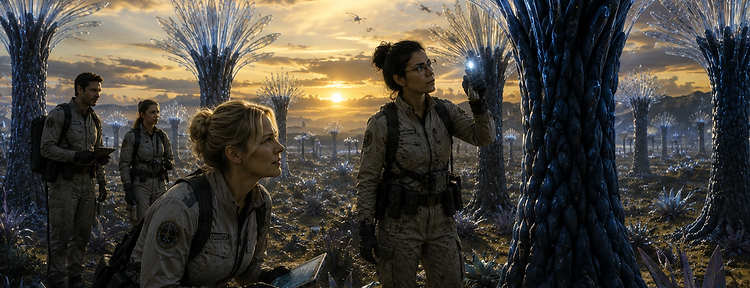
The first route segment was deliberately conservative: Proxima Centauri, Wolf 359, Epsilon Eridani, and Ross 128. They were close enough to Sol that nobody aboard could pretend they were entering the unknown frontier. That was useful. If the procedures failed here, there would be no excuse later on Amber and Red worlds where security, weather, geology, and wildlife would all become less forgiving.
GIORODVA revised the watch schedule without being asked. Jules protested that a senticom who never slept had an unfair advantage in scheduling people who did. GIORODVA replied, very pleasantly, that this was correct. Patrick offered to take every night shift and then spent twenty minutes explaining why this would deprive the biological crew of character-building exhaustion. Andrew threatened to turn him off. Patrick reminded him that he did not possess an off switch in any location Andrew was authorized to access.

Proxima Centauri Lyrudia
Star-chart anchor: Proxima Centauri / Lyrudia, approximately 4 light-years from Sol.
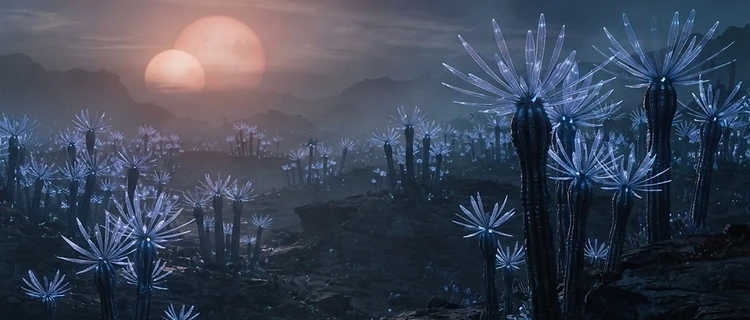
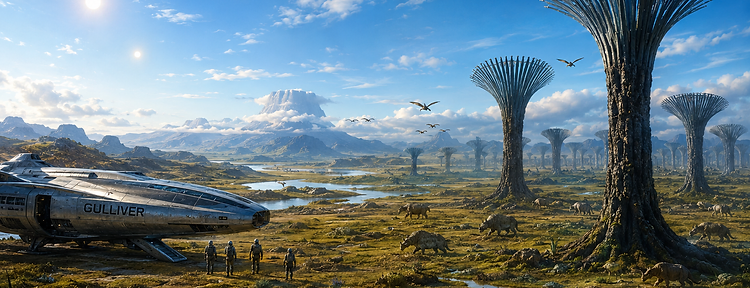
Lyrudia was the first true test because it was familiar enough to be dangerous. There were plains. There were upright producer forms. There were small flying things. There were animals that ran when approached. Every one of those sentences invited a Terran word that Marissa was trying not to use.
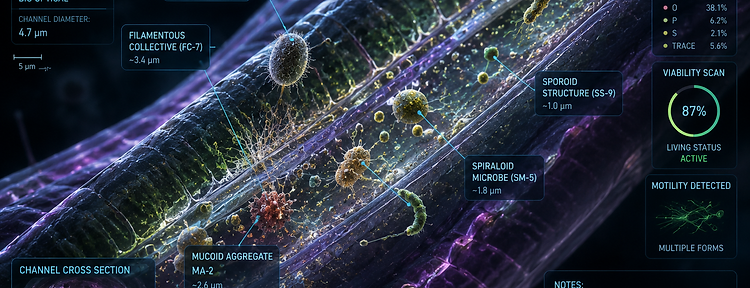
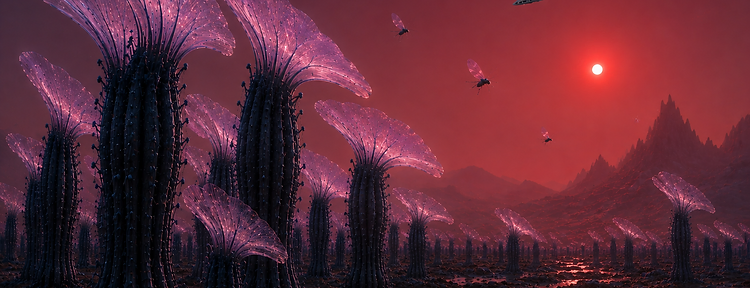
The dominant lowland producer grew in groves of blue-black columns three to five meters high. Each column ended in dozens of thin translucent vanes. Urshila smiled before they had even landed and said, "Quoisol." They were both wrong. For six hours the vanes tracked the brightest part of the sky. That seemed decisive until Gweneth found intact airborne microorganisms inside thousands of microscopic channels. The vanes were not primarily collecting photons. They were creating electrostatic gradients that pulled living aerosol into digestive chambers. The organism used light only to power the trapping apparatus. Its principal biological intake was filtered life.
FIELD REVISION 2-01 The Lyrudian Glass Tree
Working common name: Lyrudian Glass Tree → Lyrudian Glass Sieve
Initial: Brerokanquois › Quoisol
Revised: Brerokanzwoph › Zwophfil
Reason: Vanes tracked stellar light and resembled phototrophic foliage. Light powers capture; most acquired biomass comes from filtered aerial organisms.
Lesson: Energy-support mechanism and feeding mechanism must be separated.
Bethany did not say "I told you so." She wrote it on the back of Marissa's field slate and left it beside her lunch.


Representative Proxima Survey Organisms
| Location | Organism | Placement | Observation |
|---|---|---|---|
| Lyrudia | Glass Sieve | Brerokanzwoph › Zwophfil | Sessile column-form filtering aerial microorganisms through charged translucent vanes. |
| Lyrudia | Copperback Runner | Brerothokni › Thokgra | Six-limbed herd grazer; scrapes low producer mats with paired mineralized mouth plates. |
| Lyrudia | Ribbon Hunter | Brerokantha › Kanthavel | Low-bodied pursuit predator using lateral body flexion rather than a vertebrate-style gait. |
| Lyrudia | Bellroot | Brerokanquois › Quoisol | Subsurface producer with exposed light-catching bells; most biomass remains underground. |
| Lyrudia | Dust Pearls | Brerokanzwoph › Zwophabs | Colonial beadlike organisms absorbing dissolved organics after seasonal condensation. |
| Proxima gas giant PX-G1 | Cloud Rake | Brerokanzwoph › Zwophfil | Buoyant filterer; comb membranes strip microbial particles from atmospheric currents. |
| Moon I (Tern) | Ice Thread | Brerokanquois › Quoichem | Chemoproducer forming dark filaments along mineral-rich melt fractures. |
| Asteroid PX-A17 | Vacuum Clinger | Brerokanquois › Quoirad | Radiotrophic crust-form surviving long dormancy between energetic particle events. |

Wolf 359 Eos-7
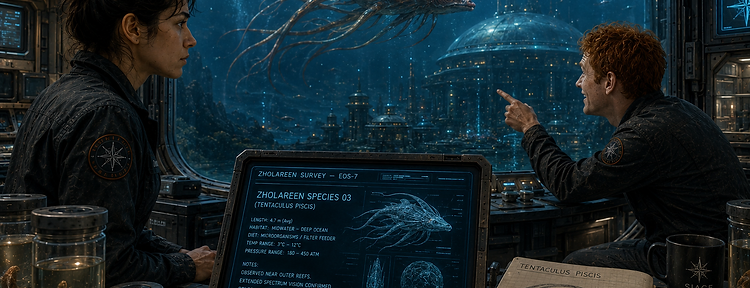
Star-chart anchor: Wolf 359 / Eos-7, 7.86 light-years from Sol. Mining operations, low population, Blue security status.
Eos-7 was the first survey conducted around substantial industrial activity rather than an almost purely biological destination. The mining authority required an armed-security liaison for access to an abandoned extraction zone. Rick spent an entire morning looking pleased with himself. Eduardo spent the same morning checking whether the liaison's credentials were genuine. They were.
The interesting life on Eos-7 lived around disturbance. Excavation exposes mineral layers, warm machinery creates thermal islands, and discarded water produces temporary habitats. It is tempting to call such organisms pests. Marissa preferred opportunists. The expedition changed the environment; the organisms noticed.
The most common was a palm-sized creature Quincy called a shovel crab despite possessing neither a shovel nor any relationship to a crab. It buried itself beneath warm spoil piles and emerged at local dusk to crop microbial films. The name survived because field science is sometimes defeated by a geologist with good timing.
Gweneth's problem arrived the next day. A flying organism landed on the back of her pressure hood. It had eight articulated limbs. She froze so completely that Patrick asked whether she had suffered neurological damage. Bethany removed it. Gweneth then watched two hours of a 20th-century black-and-white detective film through her HEILO and refused to discuss the incident.


Representative Wolf 359 Survey Organisms
| Location | Organism | Placement | Observation |
|---|---|---|---|
| Eos-7 | Shovel Crab | Brerothokni › Thokgra | Burrowing grazer of microbial mats in warmed mining spoil. |
| Eos-7 | Wirewing | Brerokanzwoph › Zwophfil | Eight-limbed flyer filtering airborne spores and dust-associated microbes. |
| Eos-7 | Red Lantern Mat | Brerokanquois › Quoichem | Producer colony using iron-rich chemical gradients near exposed seams. |
| Eos-7 | Spindle Jaw | Brerokantha › Kanthask | Small burrow-edge ambusher preying on shovel crabs. |
| Eos-7 | Waste Lace | Brerokanzwoph › Zwophdec | Pale decomposer web rapidly colonizing discarded biological waste. |
| Gas giant W359-G2 | Sail Drifter | Brerokanzwoph › Zwophfil | Gas-bladder organism drifting through temperate cloud layers. |
| Moon A | Thermal Cup | Brerokanquois › Quoitherm | Cup-shaped producer concentrated around geothermal fractures. |
| Moon B | Black Needle | Brerokantha › Kanthask | Tiny subsurface predator sensing vibration through ice. |
| Asteroid W359-44 | Stone Bloom | Brerokanquois › Quoirad | Radiotrophic crystalline-organic crust; no evidence of Discoran organization. |
Life Aboard Gulliver
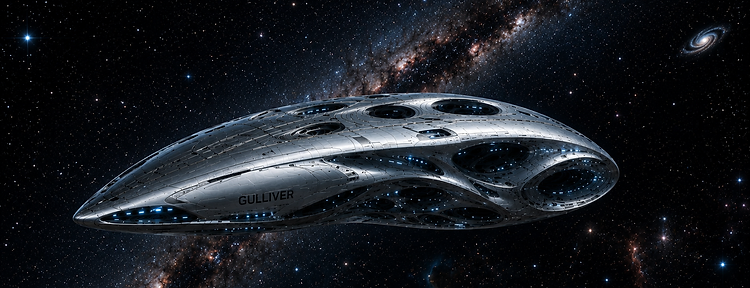
By late March, the crew had developed rituals. Bethany and Jules watched zero-G football whenever ACS delay permitted it. Bethany explained formations to anyone trapped within hearing distance. Jules understood the game but pretended not to so Bethany would become more animated. Quincy continued his campaign to make everyone watch the first season of Survivor. He insisted it was a study of coalition formation. Sabrina said it was a study of people becoming hungry on television.
Gweneth's black-and-white film nights became unexpectedly popular. Patrick supplied commentary until someone threw something soft at him. GIORODVA attended without needing a screen, which Marissa found unsettling only because GIORODVA laughed a fraction of a second before the rest of them when the media file had already been buffered into the ship's systems. GIORODVA promised to delay future laughter. This somehow made it worse.
The Wendrules became the least appreciated members of the expedition and probably the most necessary. They sterilize sample surfaces, remove dust from the common areas, clean field suits, carry sealed containers, and perform first-pass decontamination. One spent nine hours cleaning Eos-7 mineral powder from a suit hinge that Andrew insisted was already clean. The Wendrule was correct.
Patrick does not become tired. This sounds trivial until the fourth consecutive day of sample processing. He can catalogue containers at 0300, help Myriyam move equipment at 0400, make breakfast jokes at 0600, and be waiting at the airlock when the field team wakes. He is also incapable of understanding why telling a tired person that they look tired is unhelpful. Marissa suspects he understands perfectly.


Epsilon Eridani Erthuzia
Star-chart anchor: Epsilon Eridani / Erthuzian home system, approximately 10.5 light-years from Sol. Blue security status. Populated Erthuzian areas treated as culturally protected environments.
The Erthuzian hosts objected to three of the expedition's proposed common names within the first hour. They were right. Calling an organism a "four-eyed cow" because it occupies a grazing niche tells a human what to imagine but tells an Erthuzian that the expedition did not bother learning its local name. They compromised: local names remain primary where available; descriptive expedition names are used only for organisms lacking a stable translated name.
This was also the first encounter with a parasite that considered a human head desirable real estate. The animal, no larger than a fingernail, dropped from a fibrous producer and locked six soft hooks into Sabrina's hairline. It did not penetrate the skin. It merely refused to leave. Myriyam removed it with a solvent mist while Sabrina demanded that everyone stop photographing the event. Nobody had been photographing it until she said that. Quincy then did.
The parasite turned out to be a temporary fluid feeder that normally attaches to large native grazers and drinks secretions from specialized skin pits. Human perspiration apparently smells close enough to justify investigation. It was classified Brerothokni \u203A Thoksap rather than Brerokanzwoph \u203A Zwophpar because it harvests external secretions and does not establish a sustained parasitic relationship. That distinction consumed most of an afternoon and proves again that the categories are useful only when the team is willing to argue about them.

Representative Epsilon Eridani Survey Organisms
| Location | Organism | Placement | Observation |
|---|---|---|---|
| Erthuzian terrestrial site | Velvet Grazer | Brerothokni › Thokgra | Four-eyed herd animal; partially photosymbiotic skin but obtains most energy by grazing. |
| Erthuzian terrestrial site | Crown Hook | Brerothokni › Thoksap | Temporary secretion-feeder; notorious for attaching to exposed scalp and upper body. |
| Erthuzian terrestrial site | Copper Fan | Brerokanquois › Quoisol | Broad radial producer that folds during storms. |
| Erthuzian terrestrial site | Softstep | Brerokantha › Kanthask | Nocturnal padded ambusher of small grazers. |
| Erthuzian terrestrial site | Blue Rot | Brerokanzwoph › Zwophdec | Fast decomposer producing conspicuous cobalt-colored waste pigments. |
| Epsilon gas giant EE-G1 | Mist Bell | Brerokanzwoph › Zwophfil | Floating bell-form filtering organic aerosols. |
| Large moon I | Salt Threader | Brerokanquois › Quoichem | Chemoproducer in hypersaline subsurface channels. |
| Large moon II | Glass Mite | Brerothokni › Thokbro | Tiny browser of transparent producer films. |
| Comet EE-C9 | Dormant Pearl | Brerokanquois › Quoirad | Encysted radiotrophic organism active briefly near stellar approach. |

Ross 128 Selene
Star-chart anchor: Ross 128 / Selene, approximately 11 light-years from Sol. Consortium system.
By this point the expedition had enough comparative records that superficial similarity became less persuasive, and the team became more willing to challenge Marissa before she finished speaking. Selene gave them the first organism that looked exactly like an animal and behaved, for half the day, exactly like a plant.
The Mirrorback was a knee-high, slow-moving organism with six walking limbs and a dorsal fan of reflective plates. At local dawn it climbed exposed stone, spread the fan toward the star, and became nearly motionless. Tissue analysis showed active photochemical energy storage. Urshila wanted Brerokanquois. At sunset the plates folded, the animal accelerated to a speed none of them expected, and it killed three smaller burrowers in eleven minutes.
Marissa had never been happier to be wrong.
FIELD REVISION 2-02 Selene Mirrorback
Initial: Brerokanquois › Quoisol (Photochemical producer)
Revised: Brerohurnocio › Hurnoeq
Light phase: Confirmed producer behavior
Dark phase: Active mobile predator; consumes animal tissue
Significance: First expedition-confirmed balanced light/dark switch-feeder
Lesson: The Mirrorback is why Brerohurnocio exists. Understanding a category intellectually is different from understanding it while watching a solar grazer sprint after prey.
Bethany said the organism was "a solar panel with anger issues." That phrase is not entering the formal registry. Patrick has already entered it into the informal one.


Representative Ross 128 Survey Organisms
| Location | Organism | Placement | Observation |
|---|---|---|---|
| Selene | Mirrorback | Brerohurnocio › Hurnoeq | Photoproducer in sufficient light; active predator in darkness. |
| Selene | Pebble Burrower | Brerothokni › Thokroot | Small subterranean feeder consuming producer storage nodules. |
| Selene | Silver Reed | Brerokanquois › Quoisol | Flexible photoproducer forming reflective wetlands. |
| Selene | Cup Scavenger | Brerokantha › Kanthovar | Opportunistic consumer of carrion and weakened prey. |
| Selene | Rain Skin | Brerokanzwoph › Zwophabs | Thin colonial sheet absorbing dissolved organics after precipitation. |
| Ross gas giant R128-G1 | Blue Net | Brerokanzwoph › Zwophfil | Colonial atmospheric filterer spanning several meters. |
| Moon I | Cave Lantern | Brerokanquois › Quoichem | Chemoproducer illuminating mineral caverns through waste bioluminescence. |
| Moon II | Hooktail Grazer | Brerothokni › Thokbro | Cliff-dwelling selective browser anchored by posterior hook. |
| Asteroid R128-A6 | Red Scale | Brerokanquois › Quoirad | Radiotrophic scale colony occupying sunward fissures. |
The First Month of Alien Errors
By the end of April, Marissa had stopped thinking of correction as an embarrassment and started tracking it as data. The expedition had made two major functional errors and dozens of minor ones involving locomotion, reproductive structures, social behavior, and whether apparently separate organisms were different life stages of the same Orphel. Sabrina caught one of those by comparing cellular information chemistry from a crawling juvenile and a sessile adult. Marissa had already given them separate working names. Sabrina has not allowed her to forget this.
The rule aboard Gulliver is now simple: no working name becomes stable until at least two disciplines have examined the organism, and no Brerokan assignment becomes formal until there is direct evidence of energy acquisition. Appearance is evidence. Behavior is evidence. Neither is permission to guess metabolism.
The team also learned that five organisms per location is an administrative target, not a biological statement. A site containing ten thousand organisms does not become understandable because five were selected. The five-entry registry is a comparative spine. Every site retains secondary observations, environmental DNA analogues where applicable, images, samples, and uncertainty flags.
Security Commentary
Rick's assessment of the mission remains that they are paying him extremely well to watch people kneel beside mud. He says this with satisfaction. Eduardo says boredom is what successful security looks like.
At Eos-7, Rick spent two hours helping Patrick move sealed sample cases because there was nothing threatening to monitor. Eduardo objected that this was not in the contract. Rick replied that neither was standing still. Eduardo then helped move the heavier cases while insisting he was only checking their security seals.
Their standing instructions remain unchanged: they do not interfere with wildlife, weather, terrain, microorganisms, or the expedition's own poor field decisions merely because those things become uncomfortable. They intervene when an intelligent actor threatens the expedition, or when an immediate lethal emergency exceeds the team's ability to respond. This distinction will matter later. At present, it mostly means Rick laughs when insects bite them.
Phase II Closing Entry
Journal \u2014 4 May 2365 \u2014 Gulliver, outbound
Four nearby systems have already made the Terra baseline feel provincial. The expedition found a sessile filterer that impersonates a plant, industrial-zone grazers that flourish because people dig holes, a secretion-feeder that mistakes human sweat for an invitation, and an organism that spends daylight behaving like a producer and darkness behaving like a predator.
None of this invalidates Orphetuology. It does the opposite. The system becomes useful precisely when resemblance fails. The Velkth texts did not give them a perfect set of boxes. They gave them permission to stop assuming that the history of life on Earth is the grammar of life everywhere.
The expedition is still in comparatively safe space. The harder worlds are ahead. Amber operations will require external escorts. Red operations will require more planning than Marissa cares to admit. The gas giants are already producing biological returns that deserve their own paper, and Quincy has begun lobbying for more subsurface work than the schedule allows.
Also, something bit Andrew on the chest this morning. Myriyam removed it. Andrew refuses to describe the event, Patrick has composed a song about it, and Marissa has ruled that the organism's proposed common name \u2014 Andrew's Regret \u2014 is scientifically unacceptable.
For the record, the specimen is alive, contained, and currently classified as Brerokanzwoph \u203A Zwophpar pending observation. Marissa suspects this is going to get worse.
PHASE II REGISTRY NOTE
This phase establishes detailed journal coverage for the first four post-Sol systems while beginning the master organism registry. The complete Appendix B will ultimately contain five organisms from each of five surveyed locations in all seventeen stellar systems, plus the rogue-world organisms. Organisms and secondary-body working names introduced in Phase II are proposed additions pending author approval; established star-system anchors are preserved from the supplied chart material.
Reader Discussion
0 comments
No comments yet. Be the first to discuss this story.

