
Sentry Systems
Design, roles, specifications, and employment doctrine for the KAVOE autonomous sentry families — the SMM-15, SLC-28, and SHC-78.
STATUS NOTE — The three model designations in this manual are provisional technical names. Individual model names will be assigned later. This document records the design and doctrine developed for the SMM-15, SLC-28, and SHC-78 sentry families.
1. Fundamental Sentry Doctrine
KAVOE sentries are not artificial intelligences and are not sentient. They are preprogrammed autonomous machines that execute certified task libraries, sensor-response rules, identification protocols, command hierarchies, movement solutions, and force-authority restrictions. They can identify predefined conditions, navigate, track, select among authorized responses, and carry out complex procedures, but they do not independently create goals, reinterpret orders, or exercise humanlike judgment.
SENTRIES DO NOT THINK. THEY EXECUTE.
2. Standard Model Families
Three provisional sentry families serve distinct operational roles across KAVOE ships, colonies, and installations — from medical rescue to heavy combat containment.
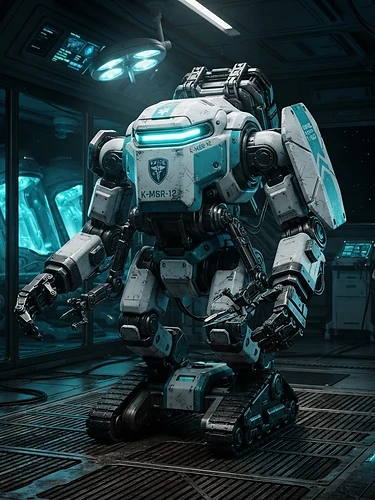
SMM-15
Sentry Medical Model 15
Medical Support · Casualty Retrieval · Containment · Medical Security
Height
~1.22 m
Mass
~245 kg
Role
Medical / Rescue
Armament
None (by doctrine)
A medical-support, casualty-retrieval, containment, and medical-security sentry. Deliberately low, broad, stable, heavily sealed, and difficult to overturn. Its mass reflects environmental protection, radiation hardening, manipulators, redundant systems, shielding, and its compact controlled-fusion power unit.
Primary Roles
- Guarding medical supplies, pharmacies, controlled pharmaceuticals, Sirona nutrient-pack stores, laboratories, and quarantine entrances.
- Entering biologically contaminated compartments to locate and retrieve injured personnel.
- Entering radiation zones, toxic atmospheres, decompressed spaces, burning structures, and other areas unsafe for unprotected personnel.
- Performing predefined casualty stabilization actions before extraction.
- Environmental sampling, contamination detection, radiation survey, and hazard marking.
- Personnel restraint when a patient or contaminated individual presents a physical danger.
Certified Casualty Logic
FIND CASUALTY → IDENTIFY IMMEDIATE THREAT → STABILIZE WITHIN AUTHORIZED PARAMETERS → EXTRACT → DELIVER TO MEDICAL PERSONNEL.
The SMM-15 is not a physician and does not improvise treatment.
Equipment and Protection
Two heavy multifunction manipulators, smaller precision manipulators, casualty restraints, emergency respiratory support, basic wound-sealing and injector systems, environmental samplers, radiation detectors, biological samplers, fire-suppression equipment, and a retractable casualty harness. Sensors emphasize life detection, atmospheric chemistry, radiation, temperature, contamination, and structural hazards.
Carries a light shield intended primarily for debris, environmental hazards, radiation bursts, heat, and limited weapons exposure during casualty extraction. Lethal armament is normally omitted because the model routinely operates around injured, confused, or neurologically impaired patients.


SLC-28
Sentry Light Combat Model 28
Commonly called 'Slice'
Mobile Combat · Security · Boarding Defense · Patrol · Restraint
Height
~1.42 m
Mass
~390 kg
Role
Light Combat
Aimed Range
~1.5 km
The standard mobile combat and security sentry. It combines substantial mass with much greater speed than the medical model. Optimized for patrol, boarding defense, corridor security, suppressive fire, hostile-organism response, and personnel restraint.
Armament and Fire-Control Doctrine
Carries a compact sentry version of KAVOE thorium rapid-fire technology with an effective aimed range of approximately 1.5 kilometers under suitable conditions. Shipboard fire-control restrictions are supplied through predefined fire-permission maps identifying pressure boundaries, reactors, fuel systems, protected compartments, and friendly personnel zones. If the firing solution violates a protected condition, the sentry withholds fire.
Suppressive fire is an authorized programmed task. A qualified controller designates the area, duration, and force authority; the SLC-28 then executes the predefined suppression pattern. It does not independently decide that suppression is tactically desirable.
Close Combat and Restraint
The SLC-28 can strike, grapple, shove, pin, and restrain. Its mass, actuator strength, lack of fatigue, and resistance to pain make it effective against hostile organisms and personnel at close range. Upper force levels require the appropriate authorization or predefined emergency condition.

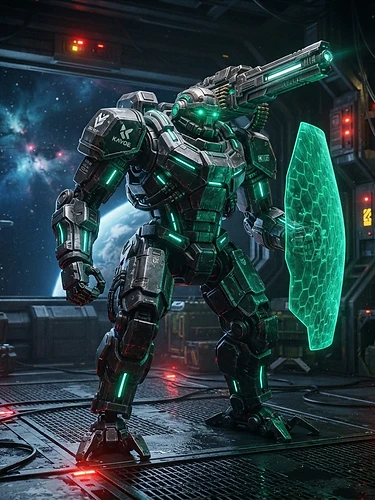
SHC-78
Sentry Heavy Combat Model 78
Heavy Boarding Defense · Fortified Security · Containment · Heavy Fire
Height
~1.83 m
Mass
~1.18 metric tons
Role
Heavy Combat
Aimed Range
~3 km
A heavy armored combat and containment sentry employed for heavy boarding defense, fortified security, dangerous-organism containment, hostile-environment operations, and threats that lighter sentries cannot physically stop.
Armor, Shields, and Power Allocation
Combines substantial physical armor with a heavy shield generator capable of sustained protection against small-arms fire and limited heavier attacks. Its instruction set or authorized controller can prioritize available power among shields, movement, weapons, and sensors. These priorities are command functions rather than independent tactical judgment.
Weapons and Heavy Melee
The standard ranged system is a heavy sentry RFG with an effective range of approximately 3 kilometers in suitable conditions. Mission-specific modular weapon mounts permit different configurations for ships, colonies, containment facilities, and military installations.
The SHC-78's mass and manipulators are themselves major weapons. With an approximate 1,200-kilogram manipulator lift capacity, the unit can grapple large organisms, pin targets, block corridors, pull hostile organisms away from casualties, or hold dangerous appendages. Retractable deck-gripping structures allow it to brace against surfaces so actuator force does not simply drive the sentry backward.
6. Fusion Power and High-Output Operation
All three families use compact controlled-fusion power units supplemented by high-discharge energy-storage systems. Fusion provides long-duration baseline power, while secondary storage supports sudden shield, weapon, sensor, and actuator demands. The listed high-output durations do not mean the fusion reaction simply stops at the stated time. They represent the certified continuous high-output envelope before fuel/feedstock, coolant, heat rejection, mechanical servicing, or other consumables require attention.
7. Movement and Environmental Capability
Certified independent deployment range is a doctrine limit rather than the absolute distance a sentry can physically travel. Communications, navigation, maintenance, command integrity, recovery, and mission control establish the practical range. When attached to a ship or installation and periodically serviced, sentries can conduct long-duration patrols. All three models are vacuum capable. EVA movement uses handholds, magnetic or mechanical gripping systems, and small maneuvering thrusters. They are not spacecraft. SMM-15 and SHC-78 models receive particularly extensive radiation hardening for casualty retrieval and operations in environments that would impose unacceptable exposure on personnel.
8. Command, Identification, and Force Authority
Every sentry operates from authenticated instructions defining authorized personnel, protected personnel, hostile classifications, restricted zones, task priorities, permitted weapons, and maximum force. Pattern recognition and sensor fusion allow the machine to classify predefined objects and conditions, but classification remains subordinate to programmed rules and authenticated command data. Certified task instructions include: guard a medical store; prevent unauthorized entry; retrieve casualties from a contaminated zone; survey a radiation compartment; restrain a designated person; suppress a designated firing sector; prevent a hostile organism from crossing a specified bulkhead; and hold a position until relieved or disabled.
9. Hacking, Corruption, and Security Doctrine
The sentry's greatest operational vulnerability is the same feature that makes it predictable: instruction dependence. A corrupted or maliciously altered instruction set can cause a perfectly functional machine to execute the wrong task. A sentry that has been given false identification data does not become hostile by choice; it follows incorrect instructions.
- Command and software updates require authenticated sources.
- Medical and EBC sentries use segregated security networks where practical.
- Critical changes to personnel classification or force authority require redundant verification.
- Loss of command integrity triggers predefined safe-mode behavior rather than free-form autonomous action.
- Compromised sentries are isolated from the network and physically disabled or contained when necessary.
- Sentry behavior logs are preserved for technical, medical, and legal review after significant incidents.
10. Medical-Ship Employment
Asherah-class medical ships employ sentries primarily to protect patients, medical stores, quarantine boundaries, laboratories, rescue bays, and medical personnel. SMM-15 units perform most contaminated-area retrieval and medical-security work. SLC-28 units provide mobile security and boarding defense. SHC-78 units are reserved for major containment failures, dangerous organisms, or situations requiring heavy physical or weapons force. Within medical areas, nonlethal and restraint responses are preferred. Lethal force is reserved for circumstances in which an immediate threat to patients, crew, or containment cannot be stopped by lesser authorized force.
11. Working Design Summary
Future revision item: assign formal individual model names while retaining SMM-15, SLC-28, and SHC-78 as technical designations.

