

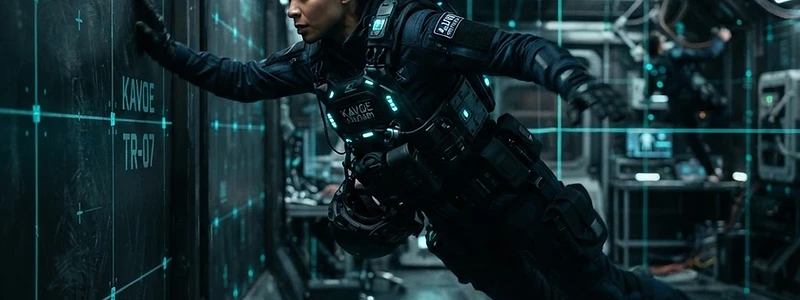
200-Meter Zero-G Inertial Transit
Crossing a zero-gravity chamber under 150 lb of inertial mass — momentum management and controlled arrival.
OVERVIEW
The candidate must cross a 200-meter near-zero-gravity chamber while wearing a fitted vest carrying approximately 150 lb (68 kg) of additional inertial mass. The chamber is located on a planet. A controlled Gorbillian manipulation system suppresses the local gravitational effect inside the test volume, causing the vest to lose effective weight while retaining its inertia. The event measures three-dimensional spatial orientation, push-off efficiency, momentum management, rotational control, braking and arrival control, and composure in zero gravity. The candidate must not merely cross the chamber quickly; the transit must end in a controlled arrival.
Scoring Summary
MALE
Measured in: transit time
FEMALE
Measured in: transit time
Standard scale: 10–30 points. Extended Performance Scale (EPS) is permitted above 30 points.
Event Details
01Chamber and Starting Configuration
The standardized test chamber is 200 meters long and approximately 30 meters in diameter. The candidate begins secured to a starting platform with both feet against a standardized launch surface and the inertial vest fitted tightly to the torso. At the start signal the restraint releases, and the candidate may push from the launch platform using the arms and legs. Once completely clear of the platform, the candidate may not return to it. Fixed maneuvering structures are positioned within the chamber and may be used for additional pushes, course corrections, rotation control, or braking.
02Permitted and Prohibited Movement
Candidates receive no maneuvering jets, propulsion packs, powered gloves, magnetic grapples, or personal Gorbillian assistance. After launch, movement must result from the initial push, body rotation and counter-rotation, conservation of momentum, and physical interaction with authorized fixed chamber structures. The Gorbillian system creates the near-zero-gravity environment but does not propel or steer the candidate. Different movement strategies are permitted, including a powerful initial launch followed by terminal braking or a sequence of smaller pushes and corrections.
03Standard 10–30 Point Scale
The male minimum qualifying time is 110.0 seconds and the female minimum qualifying time is 143.0 seconds, each earning 10 points. Maximum standard performance is 80.0 seconds for males and 104.0 seconds for females, earning 30 points. For males, every 1.5-second improvement earns one additional point. For females, every 1.95-second improvement earns one additional point, preserving the established 30-percent additional-time relationship.
04Controlled Arrival Standard
At the 200-meter endpoint is an instrumented terminal capture structure. Crossing the finish plane alone does not complete a valid transit; the candidate must make controlled contact with the capture structure. For standard scoring, terminal contact velocity must not exceed 2.0 meters per second and the candidate must contact the structure torso-first, hands-first, or feet-first within the authorized capture zone. A terminal impact above 2.0 m/s invalidates the attempt because operational zero-gravity movement requires the candidate to arrive capable of immediately functioning rather than merely surviving the crossing. The capture structure includes energy-absorbing safety systems, but those systems do not convert an excessive-impact attempt into a valid score.
05Measurement and Trajectory Recording
The candidate wears a PAT transponder while chamber optical systems continuously record position, velocity, acceleration, rotation, authorized-surface contacts, and terminal impact velocity. Timing begins when the starting restraint releases and ends when the candidate achieves valid contact with the terminal capture structure. The system retains a complete trajectory map for diagnostic review. Ordinary navigation errors do not generate artificial time penalties because inefficient pushes, excessive rotation, and poor course corrections naturally consume additional time.
06Failure Conditions
The event is failed if the candidate exceeds the maximum qualifying time, fails to reach the terminal structure, exceeds the 2.0 m/s terminal-impact limit, removes or manipulates the inertial vest, receives unauthorized assistance, deliberately uses a prohibited safety-only chamber surface for propulsion, or is medically terminated. Temporary uncontrolled rotation, lateral drift, missed maneuvering structures, and inefficient pushes do not automatically invalidate an attempt if the candidate recovers and ultimately completes a valid transit within the qualifying standard.
07Extended Performance Scale (EPS)
Event 6 permits Extended Performance Scale scoring above 30 points. EPS performance requires both faster transit and increasingly precise terminal control; speed alone cannot earn extended points. This preserves the event's operational purpose and prevents candidates from converting unsafe terminal velocity into a scoring advantage. EPS thresholds above 36 points remain intentionally undeveloped. Future extensions should continue requiring increasingly difficult combinations of transit speed and terminal control rather than rewarding speed alone.
08Training Progression
Candidates begin with ordinary zero-gravity familiarization without additional inertial mass and then progress through increasingly heavy training loads before using the full 68 kg vest. Training emphasizes controlled push-offs, three-dimensional spatial visualization, body rotation, counter-rotation, braking, momentum prediction, and the ability to plan several movements ahead. Brute strength can improve launch acceleration but may become a liability if the candidate creates more momentum than can be safely removed before arrival. The event therefore rewards judgment and movement efficiency as strongly as raw physical power.
09KOTA Instructional Principle
“Acceleration is a decision. Momentum is a commitment.” KOTA instructors use this principle to emphasize that every push creates a future control problem. The lesson applies directly to zero-gravity movement and also reinforces the broader officer-development concept that decisions create consequences that must later be managed.
PREVIOUS EVENT
Dash Test

