
100-Meter Confined-Space Crawl
Mobility, anaerobic endurance, and psychological control in a progressively restrictive tunnel.
OVERVIEW
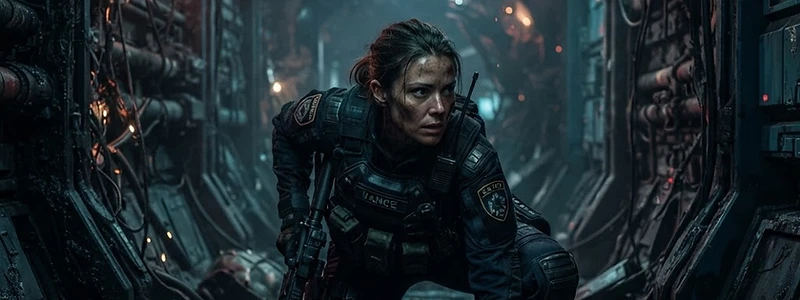
The 100-Meter Confined-Space Crawl is a timed PAT event conducted in a standardized enclosed tunnel that becomes progressively more restrictive. Early portions permit relatively normal crawling, while later portions require low crawling, shoulder rotation, lateral movement, deliberate body positioning, and controlled movement through a constriction no more than 0.50 meters wide. The event measures mobility, anaerobic endurance, spatial problem-solving, movement economy, and psychological control in a confined environment. It represents damaged starship corridors, maintenance conduits, collapsed structures, tunnels, and rescue spaces in which normal upright movement is impossible.
Scoring Summary
MALE
Measured in: completion time
FEMALE
Measured in: completion time
Standard scale: 10–30 points. No Extended Performance Scale — capped at 30 points.
Event Details
01Body-Size Principle
Smaller candidates may possess a natural advantage in this event, and KOTA does not adjust scoring times for body size. The PAT does not attempt to eliminate every natural physical advantage; instead, it determines whether every future KAVOE officer can solve several different kinds of physical problems. A smaller candidate may excel in the confined-space crawl, while other body types may hold advantages in sprinting, load handling, or other PAT events. Candidates must still satisfy KAVOE height, weight, medical, and equipment-fit requirements. KOTA does not encourage unhealthy weight loss or body-mass manipulation for the purpose of improving a crawl score.
02Standard 10–30 Point Scale
The working minimum qualifying benchmark remains 90.0 seconds for males and 117.0 seconds for females. The maximum standard score of 30 points is earned at 60.0 seconds for males and 78.0 seconds for females. For males, each 1.5-second improvement from the 90-second minimum earns one additional point. Female timed benchmarks preserve the established relationship of approximately 30 percent more permitted time. Unlike the Breath Hold, the Confined-Space Crawl is capped at 30 points; faster performances remain 30/30 so candidates are not rewarded for increasingly dangerous behavior inside a restrictive structure.
03Standardized Tunnel Configuration
The final 20 meters should not be a continuous half-meter tube. The narrowest segment should occupy only part of that zone, after which the passage expands enough to require another change in movement technique. This keeps the event focused on adaptation and confined-space control rather than turning the entire final section into a simple measurement of body size.
04Timing and Measurement
The candidate begins with the entire body behind an electronic start plane. Timing begins with the start signal and the candidate's break of that plane, while optical sensors and embedded tunnel nodes track movement through all five course zones. Timing stops when the candidate's torso crosses the 100-meter finish plane. Split times may be recorded for each 20-meter zone so instructors can identify where performance deteriorates. The tunnel geometry and distance are surveyed and calibrated so results from different KOTA centers remain directly comparable.
05Contact, Penalties, and Attempt Validity
Normal contact with tunnel walls is permitted and does not produce a penalty because elbows, knees, shoulders, feet, and the back may legitimately be used for propulsion and positioning in a narrow passage. A candidate may not deliberately damage the tunnel, remove or bypass course components, use unauthorized equipment, receive physical assistance, or avoid a required constriction. Failure to complete the course within the maximum qualifying time is a failed event. If a candidate becomes physically trapped or presents a safety concern, an instructor may terminate the attempt and activate the tunnel extraction system. Safety termination procedures take precedence over scoring.
06Psychological Component
The tunnel becomes progressively darker as it narrows, although emergency illumination and monitoring remain active. The most restrictive portions are quiet enough that candidates may primarily hear their own breathing, movement, and contact with the passage. This controlled sensory reduction is intended to expose panic responses and test whether the candidate can continue solving a physical problem while experiencing confinement. A candidate who physically fits through the 0.50-meter constriction but freezes there has demonstrated an operational limitation that the event is specifically designed to identify.
07Training Guidance
Preparation should use progressive tunnel exposure, beginning in wider passages and gradually advancing to narrower configurations. Mobility work should emphasize shoulders, hips, thoracic rotation, ankles, and rapid transitions among crawling positions. Repeated 20–50-meter crawling intervals build the unusual muscular and anaerobic endurance required, while normal KAVOE SWORT provides underlying cardiovascular conditioning. Rescue training, maintenance-conduit exercises, and controlled confined-space drills provide strong operational preparation. Candidates should not attempt unhealthy weight loss merely to improve performance in the narrowest section.
08Performance Interpretation
The event combines mobility, anaerobic endurance, spatial problem-solving, and claustrophobic control. A fast candidate who loses composure in the narrow section is not demonstrating the same capability as a candidate who moves efficiently throughout the entire course. The standard scoring result remains time-based, while split data and instructor observations provide diagnostic information for training and remediation. The standard maximum is 30 points, and there is no Extended Performance Scale for this event under the current working design.
PREVIOUS EVENT
Controlled Breath Hold
NEXT EVENT
Heavy Iron Block Overhead Hold

